Dreadnaught

Daily writing prompt
Tell us about the last thing you got excited about.

Excited? Well the other day I cleared the workbench of a small pile of small jobs that have kept me form startting work on mt portrait of the Clippership Dreadnaught. All I have to do now is vacuum and place the large wooden blank onto the cleaned bench and cogitate how to remove the rather vast amount of background.

It’s tempting to pull a router out- roooom, roooom! But you have better control of how the background will look when you do it with gouges. After all, part of it is the sea around the hull, and you need the contour to add depth and perception to the foreground. Also, I’d like to play with some contour in the sky with cloudscapes. Up to now I’ve painted the sky in, but how about carving the sky in? We’ll see.

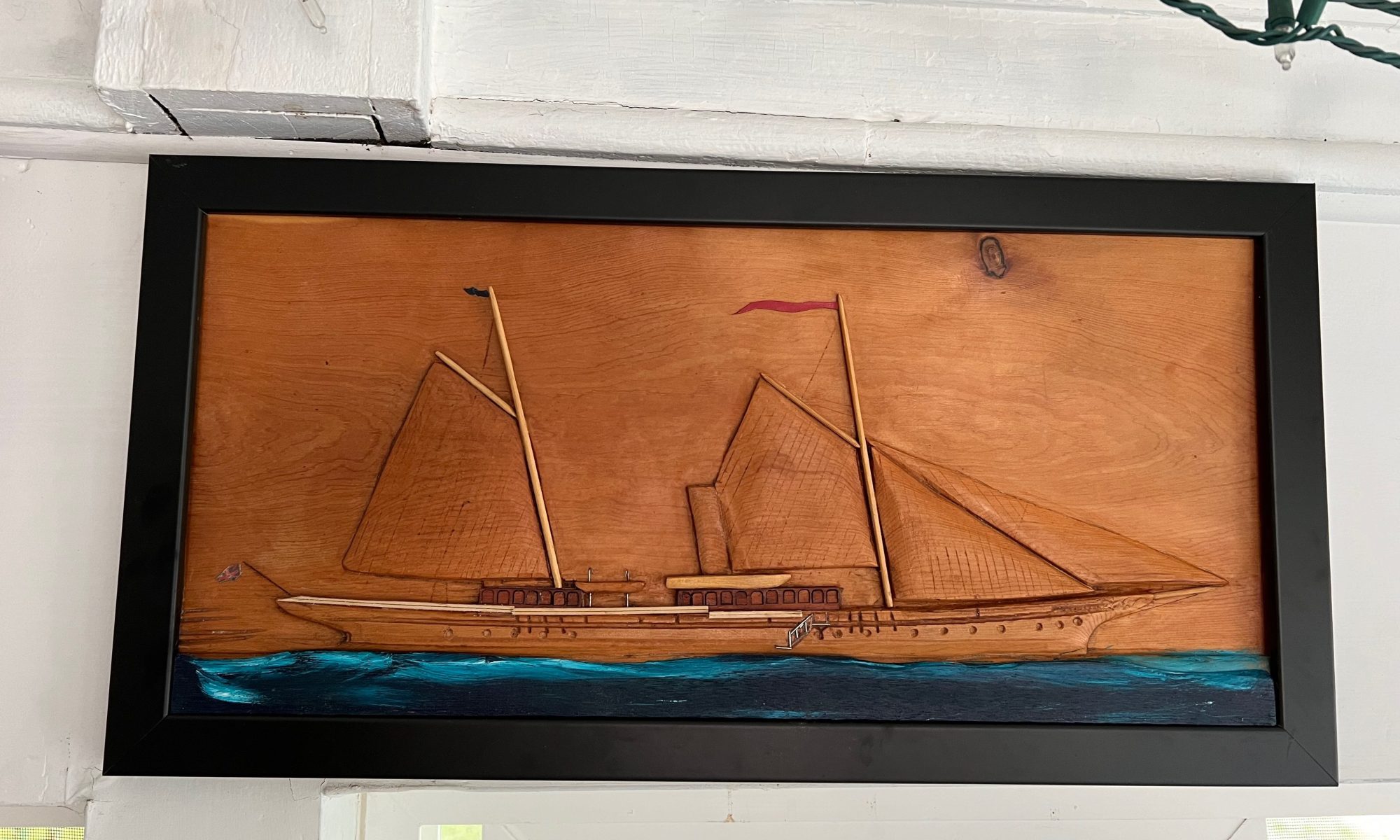
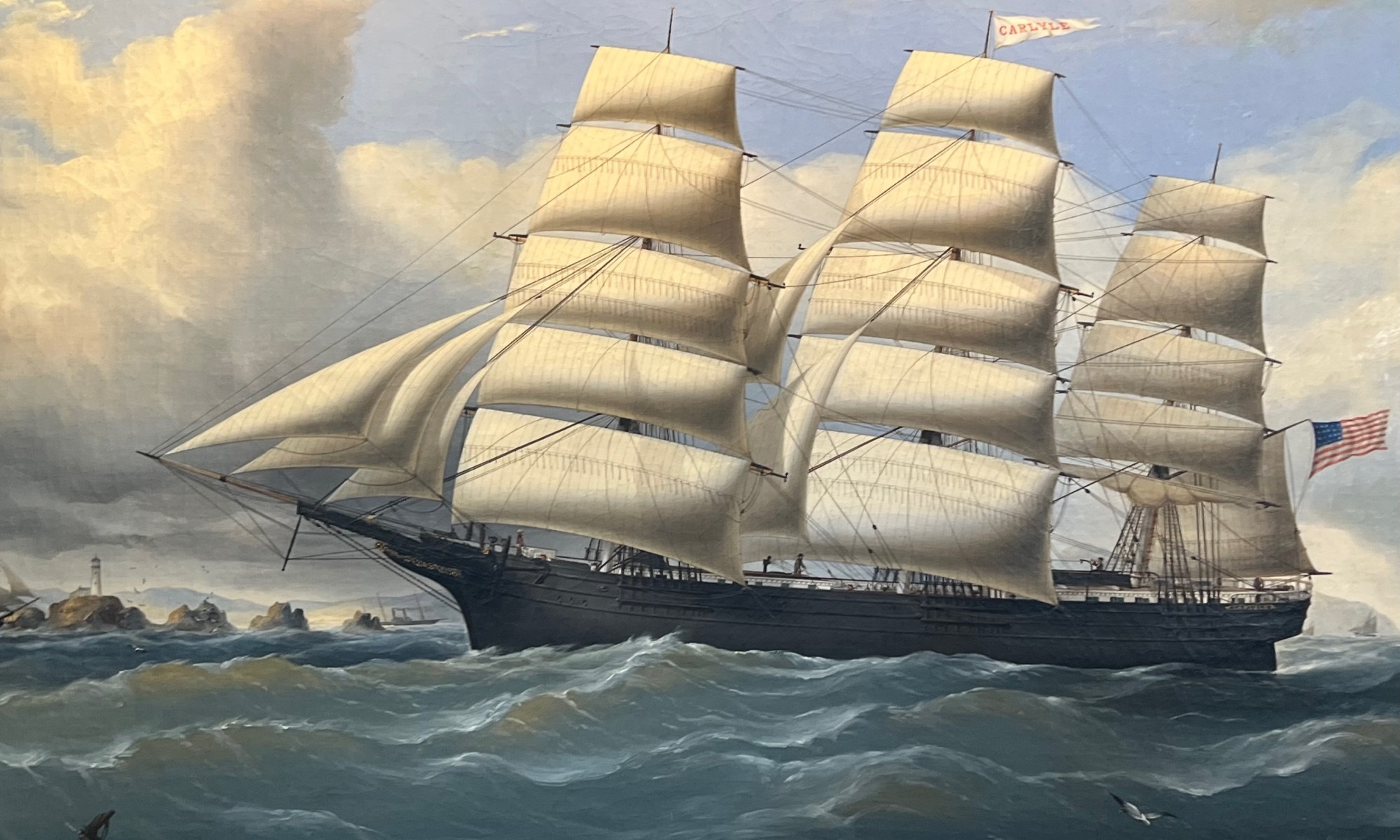
So I’ll include a small gallery of some of my other work. Part of what I’ve grown increasingly interested in is the 19th-century diorama type of ship portraiture. The ship doesn’t just sit on the surface; it extends from it.

What I ‘ve done, to this point, is leave the ground flat, and allow the natural grin, and even defects, to suggest the active moving sky. So maybe I’ll allow some formations to protrude and suggest a bit more dynamic sky?

We’ll see. To a large extent, the wood dictates. Only in machine carving do you dictate to the wood. Sometimes the wood won’t take what you want to add, so a detail is excluded. But other times the wood allows you to do things you didn’t imagine possible. For the most part, I avoid metaphysical labels or descriptions for what I do. It’s a sort of tired pseudo-art talk. But the truth is that wood is a living medium, and we can manipulate it only so much before it rebels, breaks, or splinters. And that’s not whooe. Just ask anyone who has had a piece crack apart because they pushed the boundaries too far.

Carving is a dance with a partner, and partners always deserve respect.

Kingfisher

copyright you carreras - 2025

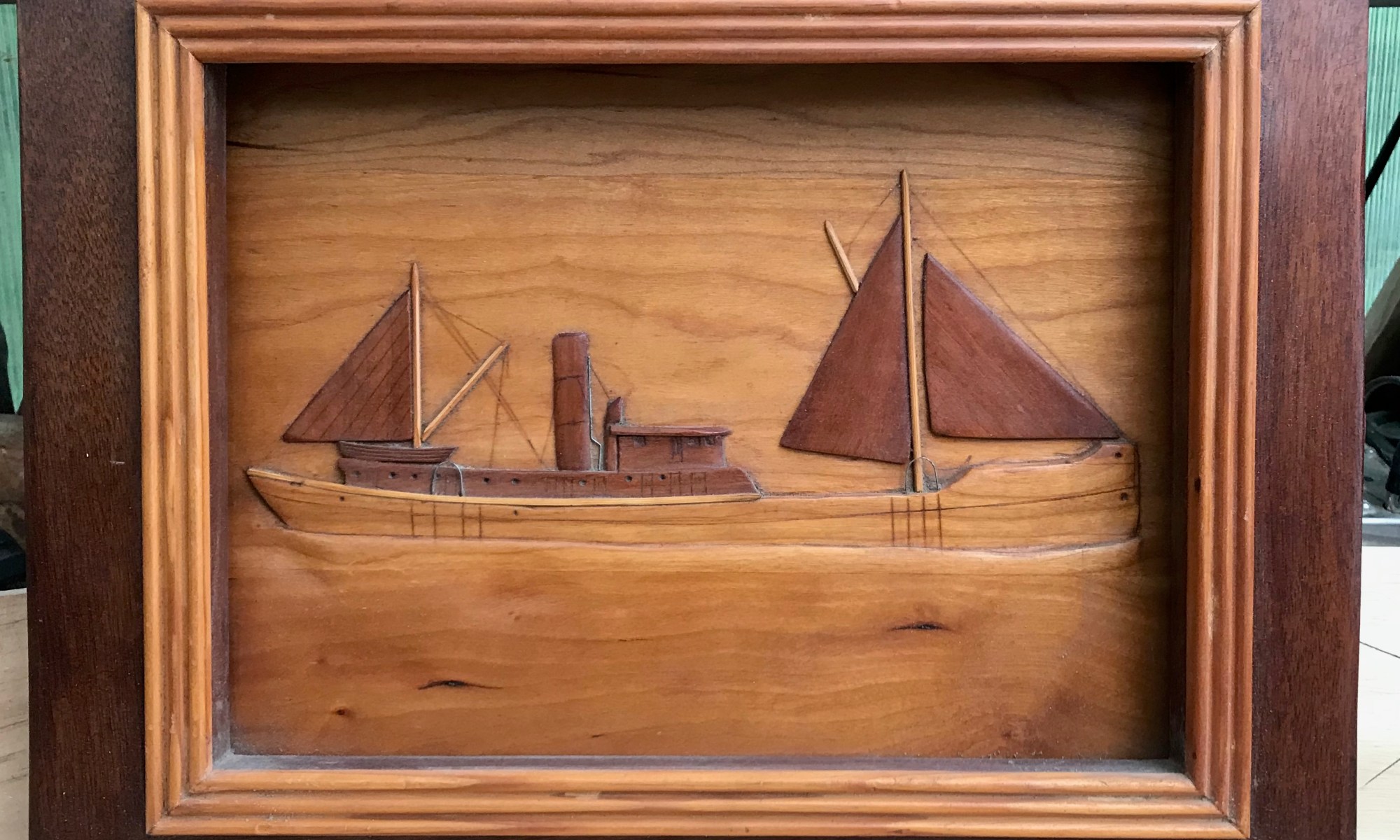
This is one of my first ship portraits. Like many firsts, there are some things to like and others to hate.

Let’s start with a descrcripion of what is going on in the carving:

The hull and background are on a piece of scrap white pine. The sails and cabinwork are cherry. And the spars are some thin doweling I had lying about the shop.

The Kingfisher was an early steam dragger (its fishing net was dragged near or on the sea bed), so there were wire “gallows” from which the”doors” of the net hung ( the fishing net was suspended between two door-like wooden frames).

I was pleased with the final piece and decided to keep it, as a sample. Eventually I decided to clean it up, and mount it for hanging when other people admired it.

That’s where the part of not liking it came in. I carved it on scrap as a practice piece, so I wasn’t careful about giving the carving any negative space around the ship. The final result is that it feels cramped and crowded.

It hung around unframed for a long time until I experimented with making frames. Since I had this on display, and it was handy, I sized the framing project to its dimensions. Now comes the second round of like and not like issues. The frame pleased me, but afterward, I noticed the mahogany framing overwhelmed the already cramped carving.

I took this piece with me to carving classes as an example of what worked and what didn’t. If you are an artist or crafter, it’s inevitable that you eventually turn out a piece that you love to hate or that just irks your sensitivities. You see the potential, and you also see where it falls short. It’s a good reminder to you about what does and doesn’t work as a design.

There are some additional reasons why Kingfisher is on prominent display in my living room rather than stuck away. It concerns a concept from martial arts called “beginner’s mind.” The rationale behind beginner’s mind is that when we begin something new, we lack the technique we’ll gain through practice. We also have an uninhibited view of what we are doing. It’s not overlaid with all the instituted prejudice of years of practice – its fresh and maybe a bit bold. Martial artists frequently look to beginner’s mind as a way to refresh their view of the art. So should we. So, I keep Kingfisher around for perspective on where I’ve been, and occasional insight into where i may go.

The temptation is to burn a piece like this, but don’t. It’s too good for that. Enjoy it for what’s good in it, and remember to avoid the short fallings.

Study Pieces

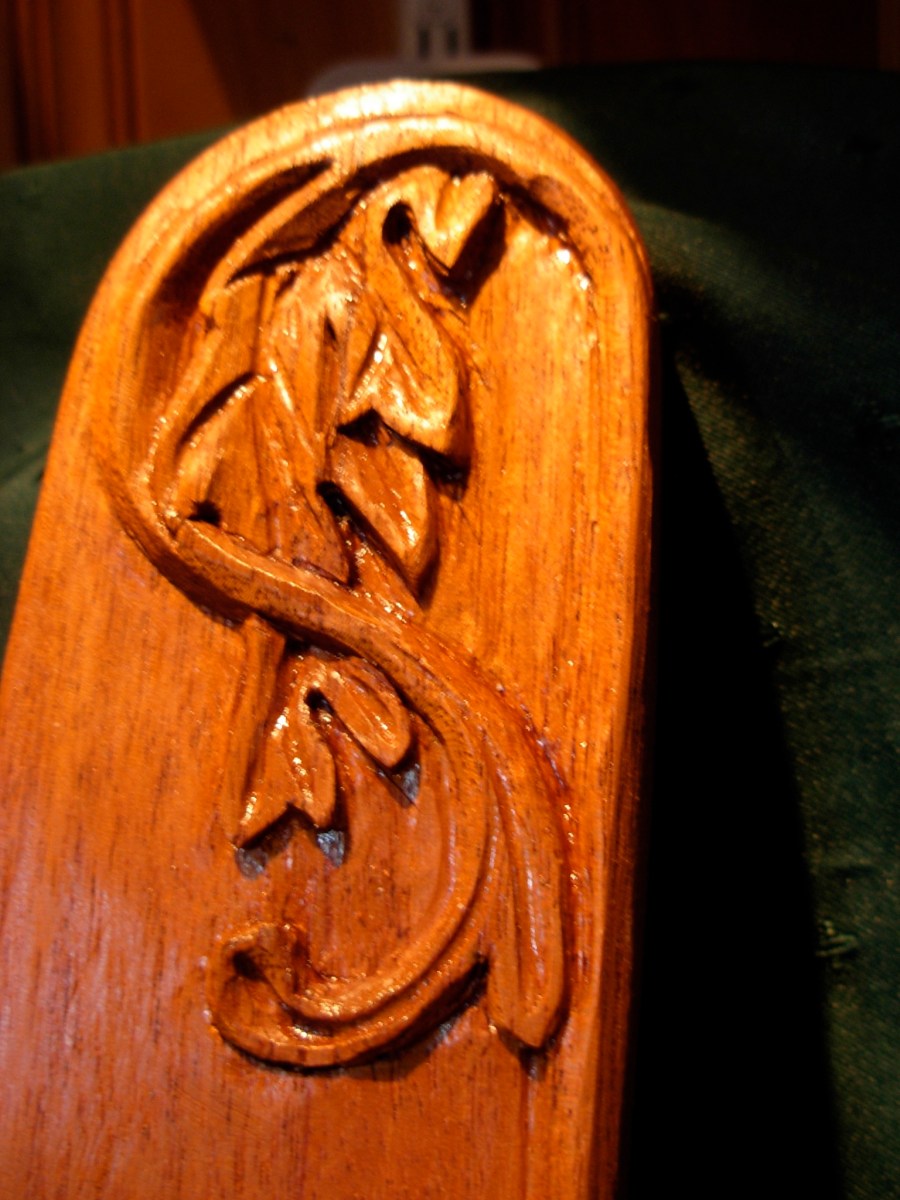
Well, only some of your explorations turn into full-fledged completed projects. About thirty years ago, a customer approached me about a billet head for their boat. Eventually, they settled on a rather uninspiring traditional carved spiral design. But I spent a little time on some quickie samples of other designs. This one was never shown to that customer. It was between a billet head and a boarding plank in style and not quite appropriate for either.
The design was dragged out of a book of traditional carving motifs. However, I modified it radically, and it’s very different from the original.

I liked it enough that it did not go into the kindling pile that winter and was stored against future use. With further modification, I might reuse it.

One of my wife’s great-grandfathers was an accomplished carver. When his house was cleaned out, boxes and boxes of small carved studies were found. He also experimented with and saved studies for future use.
We are a saving bunch.

Judy’s Number Game- September 2 – #158

So, the number 158 yielded relatively few illustrations, but ones I like. The first is from a 1930s booklet that my wife’s Great-Grandfather owned. He was a professional carver, and I used that booklet to teach myself chip carving.

Second are my chip carving knives.

The third photo is of a small box I made with a Town Class sloop carved on the top.

The fourth is a practice piece of an eagle head. I modeled this one on the lovely boarding planks on the USS Constitution. I’ve used the design frequently for walking staff heads.

The last is a fairly large cherry wood bowl. I was glad I took this shot because it flew off the table at a Christmas fair I was doing down at the coast.

The featured image at the top is a practice carving of an Eltro 19. It was my first commission for a boat portrait. I’d love to profusely thank the lady who talked me into trying this project because it changed my career as a carver in a dramatic way.

Whoops!

I play around with carving elements on the computer before I begin carving. But in this case, I wanted to play with the elements in the shop. I had run across some mid-19th-century sailors’ dioramas online and wanted to experiment further with how they brought elements together. The best way to do that was more holistically than a computer layout would allow. So, it was off to the workshop to grab oddments and physically put them into a composition.

The waved piece of wood represents the waterline. The little schooner is a practice piece I have in the shop waiting for moments like this. I’ve thought about using a carved rope molding for the frame, but the mockup makes me wonder how the entire thing will hold up while being carved. All that end grain will be exposed and weak. That’s why roped molding is straight so often. The other time I used curved rope molding was an actual rope made up for me by a marlinspike artist ( Barbara Merry).

Fantasy ship

A layout like this sometimes beats a computer layout. We can see the unexpected consequences of our planning ( or lack of it). Sometimes, our goals need to match what’s physically possible. If I continued with the rope molding as planned, it would have certainly cracked at some point.

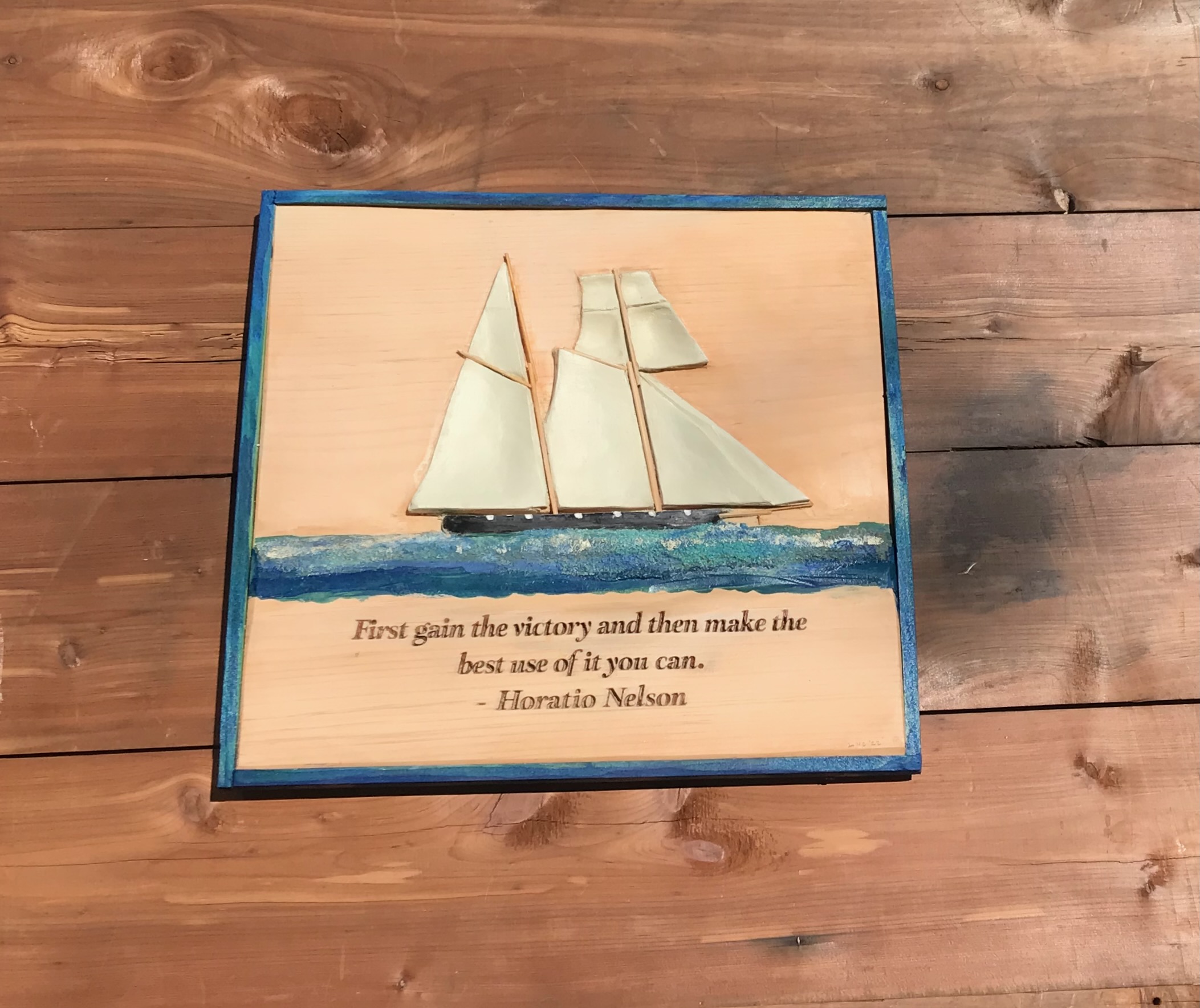
Sloop of War

Small vessels of the Napoleonic War era below the rate of the frigate were frequently termed Sloops of War. It didn’t matter if the ship was rigged as a sloop, a brig, snow, or an actual ship rig. A frigate was generally ship rigged ( square-rigged on all three masts) and had at least 28 guns on a single flush deck. 

So the handy little flush deck Sloop of War I’ve carved here is almost a pocket frigate. With twelve guns, she will not stand against a larger ship, say a Frigate, but is armed well enough to do some severe damage as a Privateer, dispatch, or reconnaissance ship. Fast and able ships like this served the British, American, and French navies throughout the era.

About the carving:

This was lots of fun to carve. I modeled the Sloop of War on several illustrations but modified things until I had the sail plan and view I wanted. The carving was executed in eastern white pine. After most of the carving was complete, I decided on a mixture of painted color and bare wood for the sort of contrasts I wanted. The sea combines crushed stone, blue ink, and acrylic paints. The quote is a favorite Horatio Nelson quote that is both era-appropriate and matches the scene.

Sailing before the wind is a challenging position to carve. It needs a bit of hollowing in the sails for drama, but it can be tricky to express. Remember you are trying to get this sense of depth and movement in 1/8 of an inch or less of carved depth.

I’ve been developing this carving style as an homage to nineteenth-century sailors’ dioramas and ships’ portraits. It’s not modeling, nor is it flat portraiture. It’s a sort of hybrid.

Generosity – a Flashback Friday presentation from July 2019

I carved this banner around when the Patrick O’Brien books like Master and Commander were popular. With so many boats being named Surprise, I thought it might be an attention-getting device at boat shows, and it was. Around the time I began to focus on portraiture, this quarterboard still looked tremendous but lost the booth space competition to portraits. It was regularly trotted off to WoodenBoat School for students to examine.
With the popularity of Surprise, I wasn’t too amazed at the number of people who’d come up and tell me that that was their boat’s name.

One year at the school, we had a Waterfront manager who particularly admired the board. He’d more than gone out of his way to help many of the students, and the students appreciated it. He became a regular visitor to our class. One afternoon while class was in progress, he was in the shop admiring the student’s work and casting glances at the Surprise quarterboard. Of course, his boat’s name was Surprise, and the poor thing was barren of any display of name. So, I reached over, grabbed the board, handed it to him, and said: “it’s yours.” I think he mounted the board almost immediately that afternoon.

We are in business to earn. But, as an artist is within your scope to please with a gift. You get as much, if not more, than the receiver out of that transaction.