The Lowly Spoon gets an upgrade

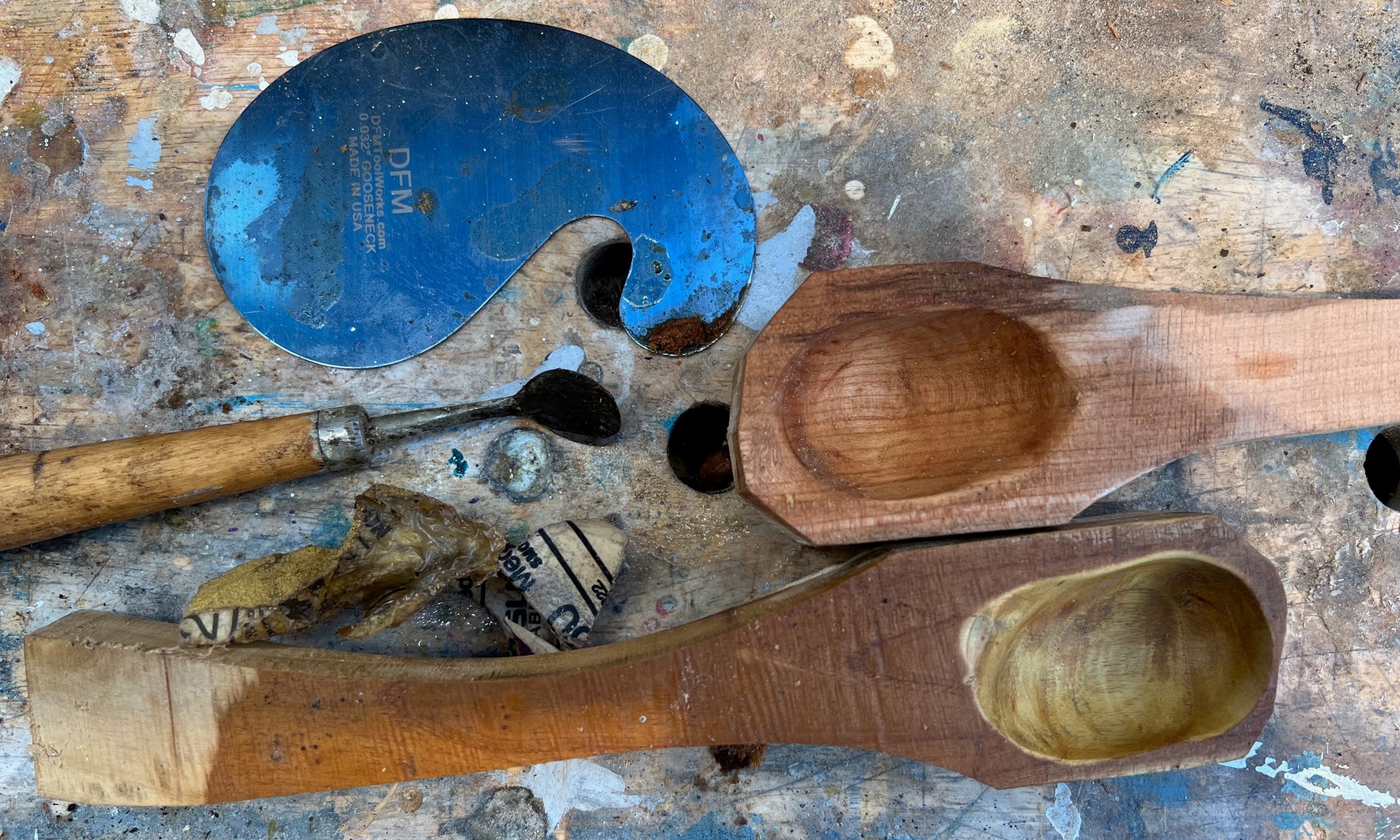
Experimentation is part of the fun of woodworking—the all-important part that separates your experience’s past from its future. The other day, I was messing about in the shop, and a new ( at least to me) method of smoothing spoon bowls came to mind.

To back up a bit, I design my spoons with various bowl shapes and handles. I’ve found that people pick up a spoon, test the grip in one or two positions, and then examine the bowl. The bowl is the clincher. If it pleases, I will have a sale and a happy customer. The idea is to “bring home the bacon,” so the extra three minutes spent on the new process is worth it.

I make two styles of bowls: carbonized and natural. Some people prefer one over the other. Carbonization works best on Cherry and sets up a very attractive contrast between the cherry’s colors and the bowl’s black interior. I feel that carbonization hardens the bowl interior and gives it that distinctive look, but to the buyer, it may just be a matter of taste.

Natural bowls have a grain structure on display and must be carefully finished for smoothness and grain exposure. It’s both aesthetic and practical concern that you want to avoid irregularities that capture particles.

Now, back to that new method for smoothing bowl interiors.

I finish most of my spoons with food-safe mineral oil ( USP from the drugstore). As part of the experiment, I dribbled some mineral oil into the bowl and then began using scrapers and sandpaper to smooth the bowl. After a while, the process left a slurry that further aided in smoothing the irregular bits. After this, they can be put aside for the handles to be finished. Scrapers are always part of my process of smoothing bowls and spoons. But the oil added a slurry that, with the sandpaper, made the process better.

The source of the inspiration? An accident. During a shop cleanup, I spilled mineral oil, some splashing on spoon blanks. The proverbial light bulb lit up, and I had an idea. I pulled a scaper off the rack, scraped the bowl with the oil, and then followed up with the sandpaper. Am I the only one who uses this technique? I don’t know. It seems too good an idea not to have been independently discovered by others as well.

Will this method be just a blip on the path to finding better methods? I don’t know. But I find it interesting that even something as ancient as a wooden spoon can get production upgrades.

Seeing Is Believing

I made some very sweet eagle-headed canes in the nineties. At one show, I sold the very best one to someone who was sightless. The details that people without visual impairment take for granted this young woman was able to take in by using her hands. I was immensely pleased, not at the sale, but to have my work so appreciated. The only other people who felt my work were children. I was continually telling parents that it was OK for kids to handle the carving. That is one of the beautiful things about carving wood- its tactile nature. I find myself hoping that people don’t just stop when they see my carving, but also touch it.
There are some things that people do automatically start stroking: spoons. I work very hard to avoid making an exact repeat. There are some lovely spoons out there that look handmade but are not. Take a look at the “family resemblance.” All the spoons and spatulas look graceful, smooth, and well designed, but there is very little individuality. Of course, I am not in the spoon business. I don’t have to turn out thousands a year to keep my enterprise solvent. I may make a few hundred if I’m doing shows. That quantity allows me to play around. I am looking for designs with excellent utility, well balanced, looks attractive, and feels nice.

To see and to feel are complementary senses. As a society, we tend to emphasize the visual at the cost of feel. That can be a mistake.
Boatbuilder Ralph Johnson drove this home to me years ago. We were planking a small boat. He asked me if the plank I had just finished shaping was fair. Based on my vision, I replied that it was. He just smiled and asked me to close my eyes and walk down the plank while I ran my thumb against the edge. As I progressed, I felt every rough bump, dip, and ding. In boatbuilders’ jargon, it was not genuinely fair.

Seeing may be believing, but feel will give you a less biased second opinion.

Gifts

From firewood to present. It’s a nice transition. As I pulled the bright reddish cherry from the piles of cordwood I began to get excited. I recognized some truly prime wood among the common red oak. A tragedy in a way, because I was thinking of the gorgeous planks for cabinet work that were now reduced to cordwood length. At least now they’ll be used for a better purpose than use as fuel.

So, wooden spoons in stunning natural cherry color. A great Christmas present for a cook. don’t you agree?

Finishing Treen – luxurious spoons & spatulas

After tempering the treen is allowed to dry for several days before finishing starts. Finishing begins with cleaning up unfair curves, and rough spots. Sanding with 80 grit, 120 grit and 240 grit sandpaper follow. A final whirl with a sanding mop ( a sort of flap sander in a drill press) acts to polish the wood.
After sanding and polishing I heat a mixture of beeswax and mineral oil. I also warm the treen. If you have the experience you can do this in a microwave, otherwise, do it in the oven. To much heat at this point will split wood, so less will be more. Just heat till the wood is warm to touch.
After the wood and beeswax mixture are both warm, I rub the treen thoroughly to cover the surfaces. In the picture shown here the treen has an excess of beeswax. That’s fine. Over hours or days it will be absorbed into the wood.
The reason for the beeswax mixture is not to make the wood look beautiful; although it does. The mixture seals and conditions the piece, so it resists moisture and the tastes and odors of cooking. At shows, I’ve seen folks pick up and smell spoons and spatulas expecting a pleasant fragrance. A subtle whiff of beeswax is pleasant, but I try to explain that you don’t want your cookware to either impart or acquire cooking odors — this is part of why we use hardwoods like cherry, maple, and apple for treen.
A final note I avoid using exotic woods. The woods that I do use are generally considered safe for use with food. Many tropical or exotic woods have toxic characteristics that make them excellent choices to avoid for food-related applications. Likewise, some oils carry risks as well. Walnut and peanut oils also are attractive on wood, but I avoid them because a customer may have an allergy to them. Oils like olive oil, safflower oil, and others I avoid because they can go rancid. There is no cure for a rancid spoon.
That’s why I stick with the beeswax and mineral oil mixture. It’s generally considered safe.
After coating I allow the treen to sit overnight. The next day I give everything a final touch up and rub down, and it’s ready to go.