
I’ve aged out of my martial arts training thanks to arthritis, but many of the lessons I learned in Judo as a young man and Iaido as an older one, persist. One of them is a Zen Buddhist concept, Shoshin – or beginner’s mind. When we start learning a new art, language, craft, or other venture, we are eager, don’t know what to expect, and are generally open to the new. We have no habits. Gradually, as we approach mastery, we develop a set of habits – maybe preconceptions of what we should do or how we should act in particular circumstances.
To an extent, this trained mind allows us to do the techniques we need to know to perform competently. From the nascent we progress to mastery: the stumbling of the first lesson, then we learn how to control the brush, gouge, or, in the Japanese Sword arts, the sword. The need is to replace the erratic with the practiced.
Sometimes we become so good at this, so practiced, that the technique becomes ingrained and can actually become a hindrance to progress further. I’ve always moved the gouge this way. We need to do this differently, but my practiced knowledge is getting in the way of doing the new. My brush strokes are like this, or I’ve always used this manner of drawing my sword in the particular kata. It can be hard to do things differently!
It’s at this point that we should seek Shoshin, the beginner’s mind. We need to get back to that place where we have no preconceptions, the eagerness to learn of the beginner, and the ability to absorb new ways to do things.
Without thinking about it, that’s what I did with the guitar. I hadn’t played for several years. When I started again about a year ago. My mind had done a reset, and I no longer automatically fell into the old muscle patterns for my right hand. I learned some new stuff. It’s interesting to see and hear what’s developing. I am sure that there are many other ways to encourage Shoshin, but this is the one that I’ve found that works best for me. I break the bonds of regular practice and allow myself to reset for a while.
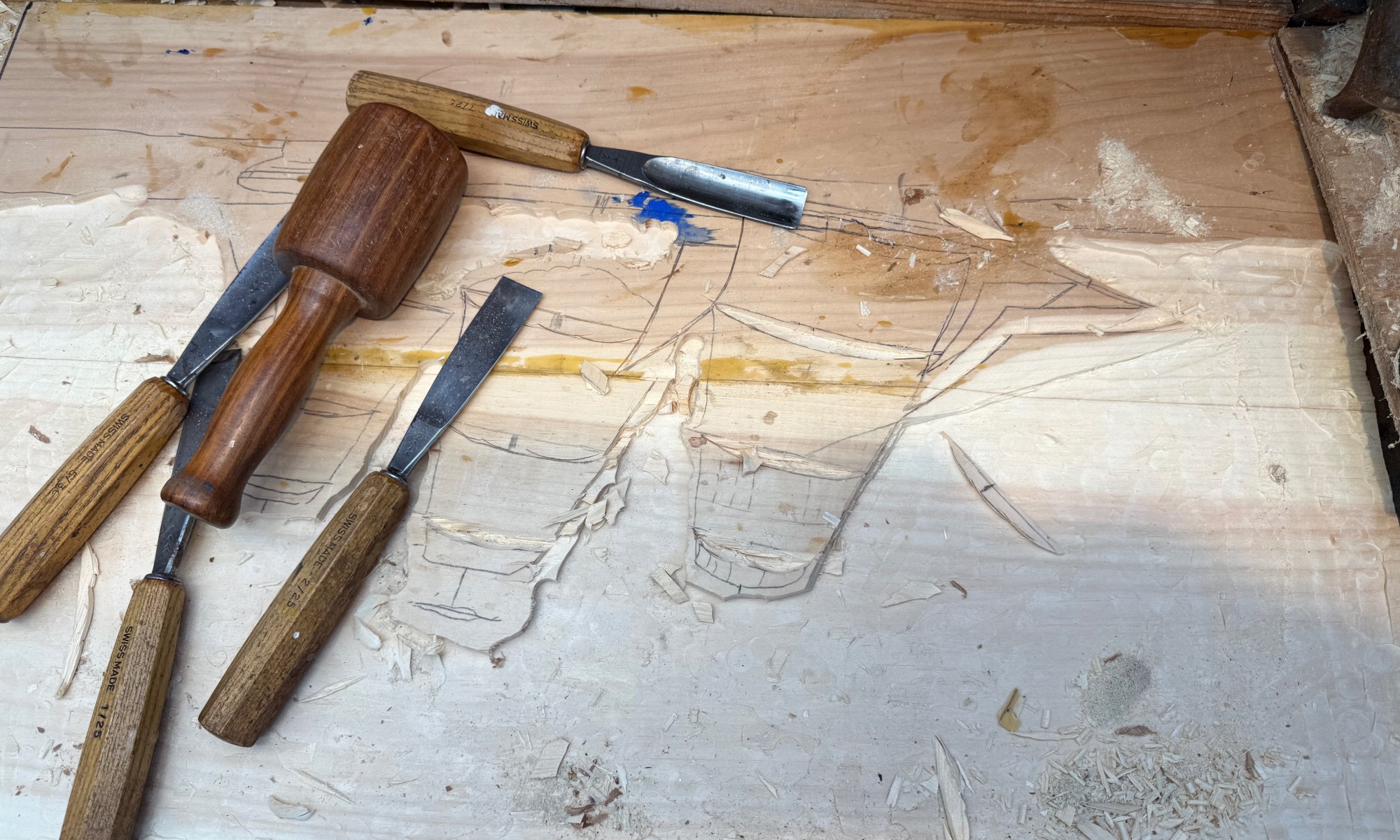
I’m doing the same thing in carving right now. I am studiously avoiding my bench and reorganizing tools. I’ve been looking at everything but the current carving of the clipper ship Dreadnaught. Sometime soon, I’ll pick up where I left off, but it’ll be a bit different. I am beginning to think that it may be the sea or sky that needs a new technique.
It beckons to me.


Discover more from Louis N. Carreras, Woodcarver
Subscribe to get the latest posts sent to your email.
I “get” and appreciate this on so many levels. I first came across “beginner’s mind” last century, when I started studying Eastern philosophy.
Then I lived with an artist, also guitarist, also martial artist. The martial art/Taoism had us discussing beginner’s mind. I’m not sure he recognized one big example he had of it, but you just described it. He was self-taught on guitar (and really really really good). He could hear a song once and play it. He created his own songs. Etc. He never studied music theory, because he was *sure* it would limit his creativity. An old friend who was a prof at a well-known music academy final goaded him into “just give it a chance.” He went into music theory with beginner’s mind, and came out of it frustrated that he didn’t do it sooner because it opened up so many new options for him.
I’m currently being angsty about my own form of beginner’s mind over on my blog.
I have to say, you do an excellent job with these WP prompts. I started my blog in 2014 and did the WP prompts for about a year and got frustrated. WP changes things up (a lot) and things just went “bleah” imho. I read the daily prompts on my dashboard and go “meh” and then I read your responses and think, “Well, that was an interesting turn!” 🙂
Shoshin, but if your friend were a martial artist, he would have gone through fudoshin (immovable mind) and then zanshin (remaining mind). In the process of mastery, you go through all of them…and then seek to return to shoshin.
The prompts? I try to hijack them if I can…but I have to admit that it sometimes sinks rather than swims.
I think an aspect of the beginner’s mind is challenge, excitement at learning a new thing, the sense of discovery. It’s a different challenge to get there when you’ve “arrived” somewhere but I think it’s the only way to keep the fire burning.
I agree, otherwise it all becomes the same old same old.
By the way, beans got planted in the garden today.
This is an interesting topic, I guess the “beginner’s mind” is also a way to adapt to changes out of our reach
Relating tho the earlier topic of neuroplasticity though, they are related.