
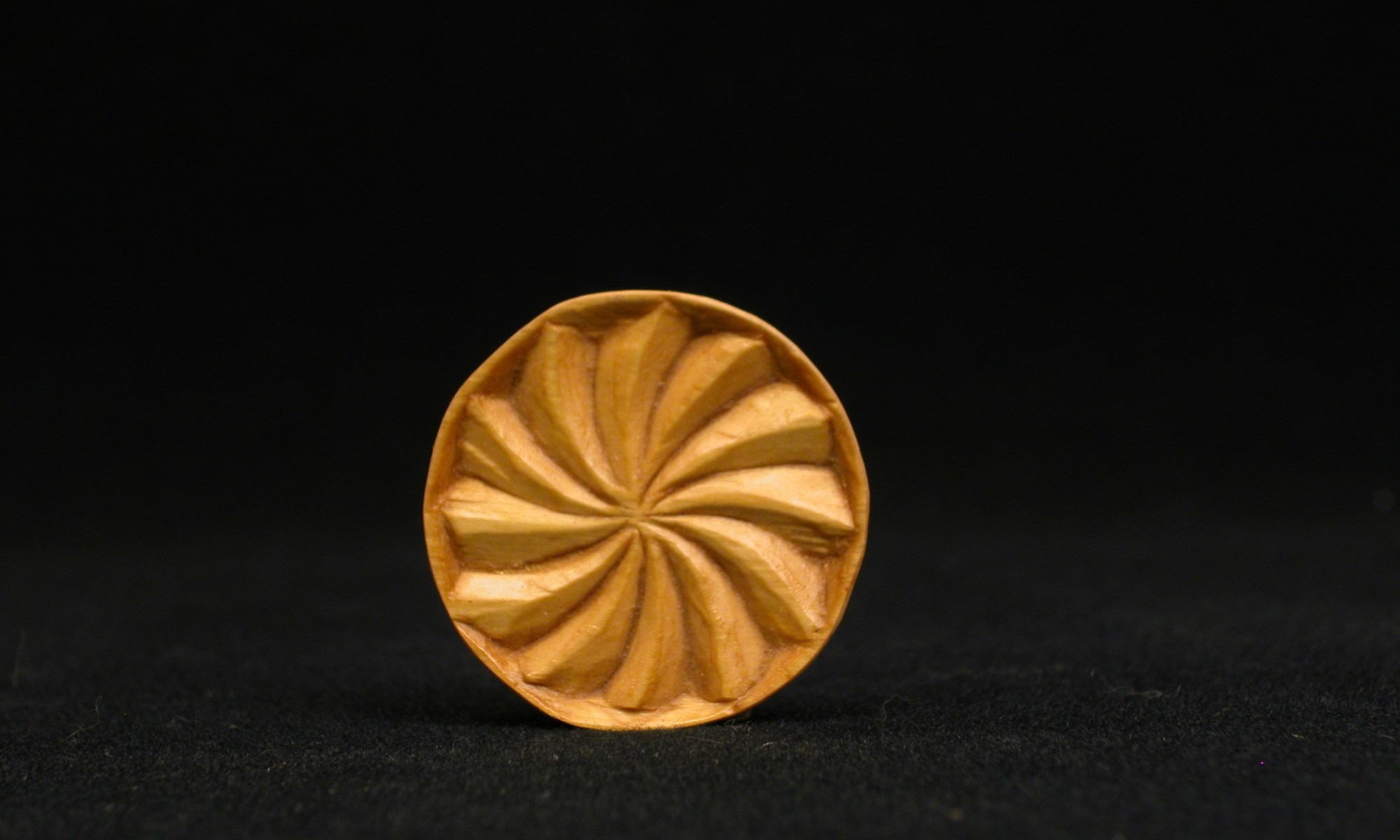
The worn and dogeared paperback copy still sits on the shelves with my many other books on woodwork and carving. It’s E.J. Tangerman’s book Whittling And Woodcarving. It’s probably been in print continuously since it’s first publication in 1936. So it’s been the introduction to carving for many thousands interested in the hobby, craft and trade. It runs about three hundred pages, and the reason its so dogeared is that, despite my owning many other specialty books on carving, Tangerman stuffed such a diverse amount of information into the book that it’s still a good general guide.
It came into my possession in Baltimore about 1968. I had started carving tiki’s as part of a crazy business with my friend. One of my jobs was to scavenge wood for our projects. One day, looking for lumber, I wandered into the studio of an ecclesiastical carver. Fascinated, I kept returning, and gradually I determined to be a better carver. Davenport’s most significant teaching was one he repeated to me until it sunk in: an artist needs to be literate in his trade, craft or skill. Skill without the knowledge of some theory, and what others have discovered, is inexcusable for a craftsman. It was frankly a revelation that had the effect of an earthquake on me. I was an avid reader, but had never been introduced to the literature on carving. The Tangerman book was not his favorite, but I was poor and it was within my means to purchase.
Right next to the Tangerman book is my hard-backed copy of Jay Hanna’s Marine Carving Handbook. I bought it literally hot off the presses when it was published in 1975. The Cap’n had decided that I should learn to carve him some fancy carved work for the ketch we sailed, and I knew nothing at that point about marine carving. In fact, I don’t think there was anything in print for many years after that other than Hanna’s excellent guide. It’s about ninety-three pages, and has about ninety percent of what you need to start in marine carving in it.
Yes, I know carving is a hot topic to a relatively small population, but these two books make a good start on a foundation shelf of texts needed to be literate in the craft. They are good enough and comprehensive enough that you go back to them for years and still learn something new.
These days, you can get computer courses, videos, podcasts, and more besides books to start you off. By comparison, a beginner today has it soft and plush. But sometimes you can have too much information, and simplicity is the best way to go.
One thing, however, has not, and probably will not change. Literacy in your craft or art still is central. So much opens up with the word and an explanation. The history, scope, and exploration of the topic are yours for the reading.
Discover more from Louis N. Carreras, Woodcarver
Subscribe to get the latest posts sent to your email.
Definitely possible to have too much information — and that is paralyzing.
And a lot of the stuff online and on video is pretentious outright wrong, or opinionated.
You are the only wood carver I know and a very interesting person you are. I enjoy all your stories.
Thank you very much. I enjoy spinning a tale and seeing how people react to it.