

A Golden Age
The gilt-edged age for the ship carver had to have been the 17th and 18th centuries. The figureheads were the least of it. There were gilded coats of arms, allegorical figures, swags, and elaborately carved moldings everywhere.
Set sail, wind up in a storm, get into a dust-up with the Dread Pirate Roberts or meet up with a French corsair, and when you came back into port, watch the carvers bill rachet skyward. Those cherubs on the starboard Quarter gallery? Somebody’s cannon blew away? They need replacing.
I doubt that carvers grew wealthy. But, there was steady work. Think of it as a handy 17th and 18th-century body shop for ships. “Here’s the estimate- we can try to save that Neptunas Rex on the transom, but it’s cheaper to replace.”
Sometime in the Napoleonic Wars, the British Admiralty began to budget the purse into which captains could dip for replacement swag. Just so much for a frigate, this for a fifth-rate, that for a third and so on. I’ve suspected that the Admiralty knew that some skippers and bosuns were in on a deal with with the carvers – ” I’ve got some cherubs this week buy them from me rather than Smithwick, and I’ll kickback 5%.” The fine art of naval chicanery in practice.
Thus began the inexorable decline and fall of the honorable trade of ships carver.
Things Change
Over on this side of the Atlantic, there were no royal purses to fund tons of gilded frippery. During the glory days of American sail, journalists would visit the docks and write a commentary on which newly arrived vessels were most tastefully attired. Many Maritime Museums display the fine figureheads that once graced the bows of the clippers.

Then along came the Quakers. They caused crews to mutiny by taking figureheads off vessels and replacing them with sober billet heads. Sail without our Jeremey Bentham figurehead? Never. Figureheads continued to have their day for a while. But, gradually, more modest accouterments became the rule. The cost was part of the reason; fancy carvings were expensive to maintain.
The following photos are from the U.S.S. Constitution Museum (for a detailed article on the Constitutions bow candy dip into this Article: https://ussconstitutionmuseum.org/2017/03/03/bow-decor/)

The first photo came off the Constitution, and the second came from H.M.S. Cyane. Both are good representations of early 19th naval billet heads, spare and none too fancy. But, great representations of the carver’s art.

The Final Era
Compared to the two-headed equestrian figurehead ( circa 1750, in the collection of the Peabody Essex Museum), the billet heads appear downright dowdy. The final billet heads are from the Penobscot Bay Maritime Museums collection. They have the distinction of being in mint condition Carved by either Thomas or W.L. Seavy of Bangor, Maine. They never were mounted on a ship and represent the end of billet heads for commercial shipping.

Here is a shot of more recent work on a contemporary sailboat.


Lastly, here is a ridiculous bit of plastic on an otherwise pretty boat.
These days a Ships Carver may get a commission for a small billet head like the ones I carved. As shown in this photo:
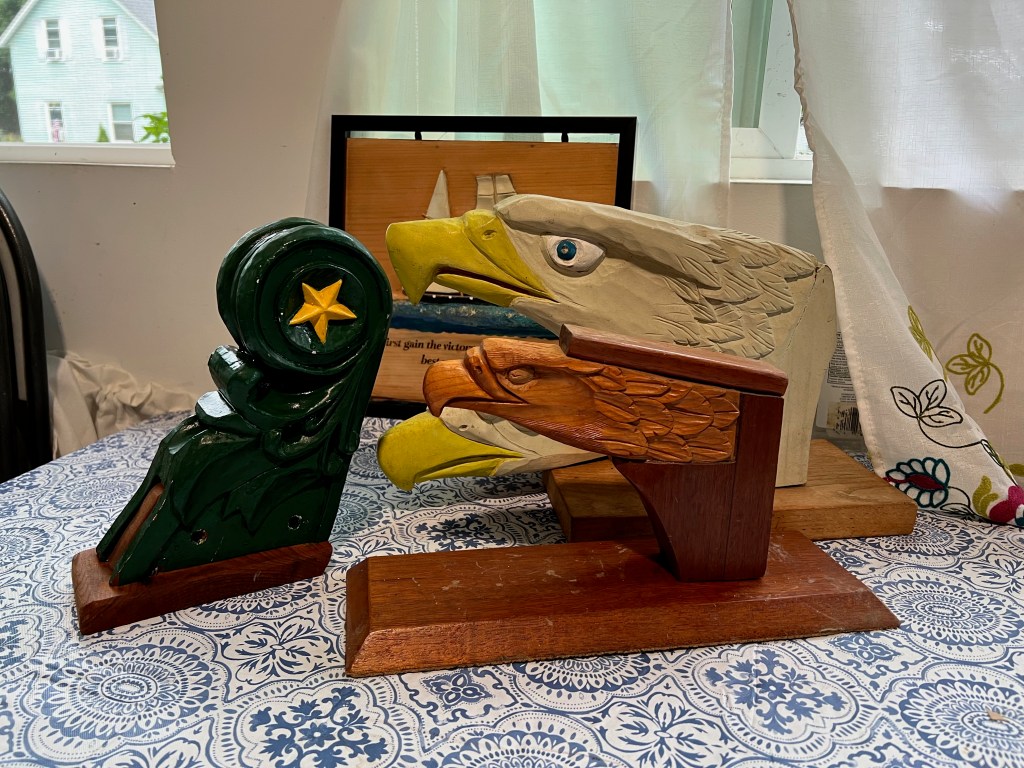
But the bulk of the work is in quarterboards, transom banners and number boards. After I stopped doing boat shows I covered the walls of the porch with the samples I’d display. It gives a fair ide of the variety of wwork people would request.

sic transit gloria mundi
Discover more from Louis N. Carreras, Woodcarver
Subscribe to get the latest posts sent to your email.
Lovely works! Had to laugh at “bow candy”!
Well, semi-clad females in the mid-19th century? How else to describe it.
I have always had so many questions about the ships that had figures of women as their “bow candy” it just seems to conflict so greatly with the superstition that woman aboard ships were bad luck. This was a very interesting write Lou.
Glad you like it. The piece is actually a simplification. Just to investigate the “bow candy” bit of semi-clad women on the bow would be a book…with lots of very racy photos and drawings.
Thank you, Lou! Very interesting!
This is wonderful, Lou! My daughter Maddie is passionate about maritime history, tall ships, pirates and the golden age of sail. Nelson is her hero and HMS Victory is her favourite vessel. We even have a pirate ancestor who sailed with Blackbeard. A few years ago I took Maddie to see the Cutty Sark in Greenwich, and they have a whole exhibition hall full of figureheads that we spent ages exploring. Neither of us had known about the Quakers’ aversion to them though, so that was news to us. And we both love your eagles billet heads, so beautiful! 🙂
Hi Alli, thanks for visiting my blog. I’m glad you found something of interest in it!
I’m looking forward to reading more, and I love your work.