Little

A Flashback Friday Presntation from March 2020:

Have little space, no time, and just a few tools? Try miniature work.
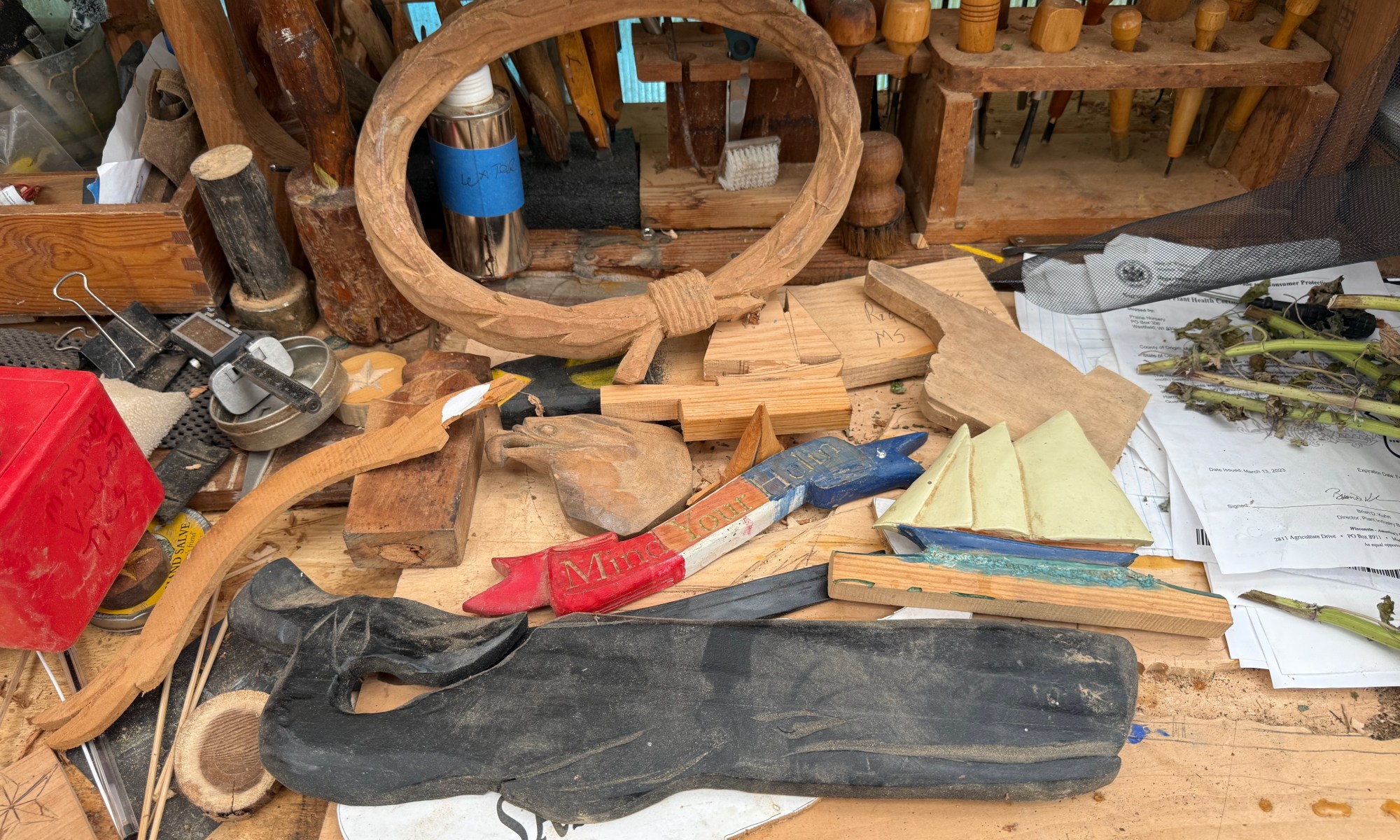
When I started woodcarving, I had just a few tools and almost no wood. I carved the little box from scraps of cherry and walnut. The tool kit for making the small sloop was minimum: a few small gouges, V-tool, and a riffler file. For work in this dimension, my bench was a handicap; I did most of it on a carver’s hook with some anti-slip fabric to hold the piece in place ( you can use woven shelf liner material or carpet underlayment). I did finish the piece in varnish, but you could do as many European carvers have done for centuries and rub the carving down with a bit of beeswax candle. The beeswax gives a beautifully mellow, soft look to the carving.

Small boat box about half finished


Access to a bandsaw made it possible for me to create a small box with the boat carving as a lid. But I created similar pieces for small glued-up business card holders and refrigerator magnets. This little boat has an LOA (lenght over all) of less than an inch and a half.
Work in small dimensions doesn’t seem to be as impressive as more substantial work, but it requires thoughtful attention to detail and forces us to focus our skills. Doing small versions can also be a way of working out design elements for later work when you scale up your design.

How Much Does this Cost?

Daily writing prompt
What is one question you hate to be asked? Explain.

How much does this cost? What I disliked at the shows were the people who came around and asked the costs of clearly marked items like the spoons made from cherry. There was always clearly marked signage on costs, and larger items were labeled. Did this stop the questions? No.

Big Stuff

At boat shows, there was always a sometimes spirited debate about how much custom work would cost. Every project depends on how much research needs to be done and how large or complex the project is. If you want a nice portrait of Dad’s little Beetle Cat, or a Town Class sloop, it’s easy. The drawings and plans are available, I’ve carved the designs frequently, and I’ll just need to know the details. Easy.

If it’s great-grandad’s schooner It may be more complex. Got a photo, painting, or drawing that’s easy. Have nothing, and I spend time in maritime museums, online, and the clock is running. But people interested in that sort of work usually understand the costs. I’m a big proponent of keeping costs out in the open and providing updates.

The Small Stuff

I always made sure that there was at least one sign listing prices on spoons, spatulas, spreaders, and bowls. During the course of the day, things would get shuffled, and it was always the small stuff that needed rearrangement. Despite the time of day, you had to make sure that a cheerful and informative response was given to each query of how much it cost; one member of a couple might buy a spoon while another could order a large carved eagle. But also, every purchase was important, and from show to show, you’d often see the same people and get repeat business. Some excellent suggestions for products would come from these customers. So even if the question was annoying, your response was important.

It was in selling the small stuff, though, that my kids excelled. My wonderful sales force. They knew the details and enthusiastically hawked the goods. Importantly, they did not mind the “How much is this?” questions, no matter how often they heard them.

Like most booths at the shows, I made good money out of commission work, but the ready-to-buy items paid for show fees, travel, food, and accommodation. I used to do the shows often with the accompanying family of four starving children who came to dinner with large appetites. After a day of running around the harbor and staffing the booth, four kids can eat up a day’s worth of proceeds from cherry spoons!

The Very Meaning of Custom

Daily writing prompt
Describe the most ambitious DIY project you’ve ever taken on.

Most often, nothing is available prefabricated when I do a portrait of a ship or boat. The same is true of an eagle or other project. The essence of “custom” is that you are doing it because someone wants it, and it is not available from a commercial source. So you have to make it all by hand. DIY? I guess you could call it that. Here are some ship and boat portrait examples:

A wooden artwork depicting a ship, featuring a detailed design in white and black against a polished wood background.
A decorative wooden wall art piece featuring a ship made from inlaid materials, displayed against a green background.
A carved wooden wall art piece depicting a sailing ship with two sails, mounted in a black frame, against a brown background with blue water at the bottom.

None of these has any commercial parts, and most of the ships I carve have no plans. With luck, I find published drawings online or a good photo. Marine carving is the ultimate in DIY.

Eagles and Sundry

Intricate wooden carving of an eagle with outstretched wings and detailed feathers.

Eagles, banners, and other things are similar. But here you do get fortunate in finding good drawings or published patterns that you then have to resize, redraw, and interpret for carving. Once again, it’s not like building a kit. The eagle from the first USS Pennsylvania was an interesting case. All I had was a photo I took at the Mystic Seaport. From that, I made a pattern I used for carving. I was interested in how my master’s, Back In The Day, modified patterns to derive different versions of eagles. I modified the pattern for a dozen eagles to see what the variations yielded.

A workshop wall displaying various wooden carvings and tools, including shaped wooden pieces and hand tools.
Pattern’s hanging in my shop

Having worked in my friend’s boatyard, where patterns hung from the rafters, informed me how to do this. Patterns get reused. Want a Payson’s Cove 25, but at 30 feet with a bit more beam and a higher sheer line? We modify a pattern with the information, and sometimes create a new one. Who knows? Someone else might want one if the design change is popular. I am reasonably sure that this was how the old timers did it. If it was goodenough for them, it works for me.

Clients sometimes have specific themes and needs; you do what you can to satisfy them:

Despite a shop full of gear and tools, the essentials of the trade are pretty much the same as would have been found in a seventeenth-century shop – gouges, chisels, planes, and shaves. Some things do not change

GO in snow

Daily writing prompt
What book are you reading right now?

Normally I am deeply buried in a sci-fi pot boiler, a book on history ( Mary Beard is a favorite) or books on gardening or woodcarving. But the prompt finds me reading a product manual. It’s the manual for a GO power snow shovel. A battery powered cordless snow shovel. The snow shovel will probably soon be joined by a similar GO snow blower, and I’ll get buried in the manual for that.

Meanwhile, in the back of the house, half covered in a tarp, lies the venerable gas-powered snow blower. Heavy, a terror to navigate around the yard, and cranky to start. Last winter, after long and hard efforts to start it, I hurt myself kicking it. Attempts to use the “electro-start resulted in an almost explosion during the last storm of the season. A change was needed.

As soon as spring started, I left it to rust. Defiant to the last, not a speck of rust has appeared. But my resolve to replace it firmed up as my sore arm twinged, thinking of another winter pulling the damn starter cord. I had a bad recollection of jerking the damned thing through the snow after it stalled out. Motivated, I began researching the alternatives to vengeful metal monstrosities fueled by petrol. After haunting big box stores and local providers of yard machinery, I decided on the snow shovel and a small blower that were battery powered.

The first snows of the winter are probably only weeks away, so we’ll find out soon if I have chosen wisely.

Chopping Out

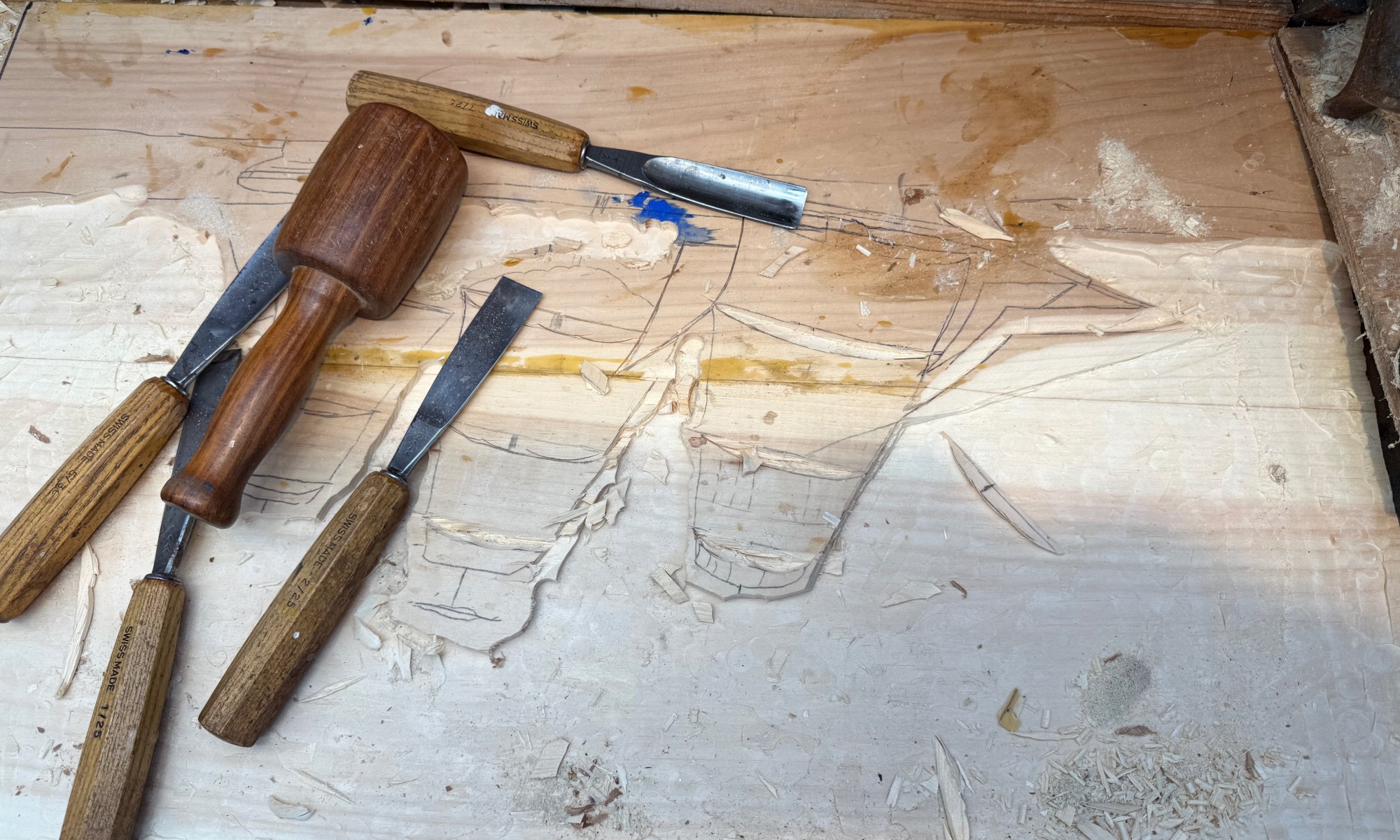
If there is one time in carving when you think about it as a big mess, this is it. I call it chopping out. You are essentially removing the waste wood, mainly the background. It’s messy, time-consuming, and necessary. You need to do this before you establish the shapes, masses, and perspectives of the work. It’s messy.

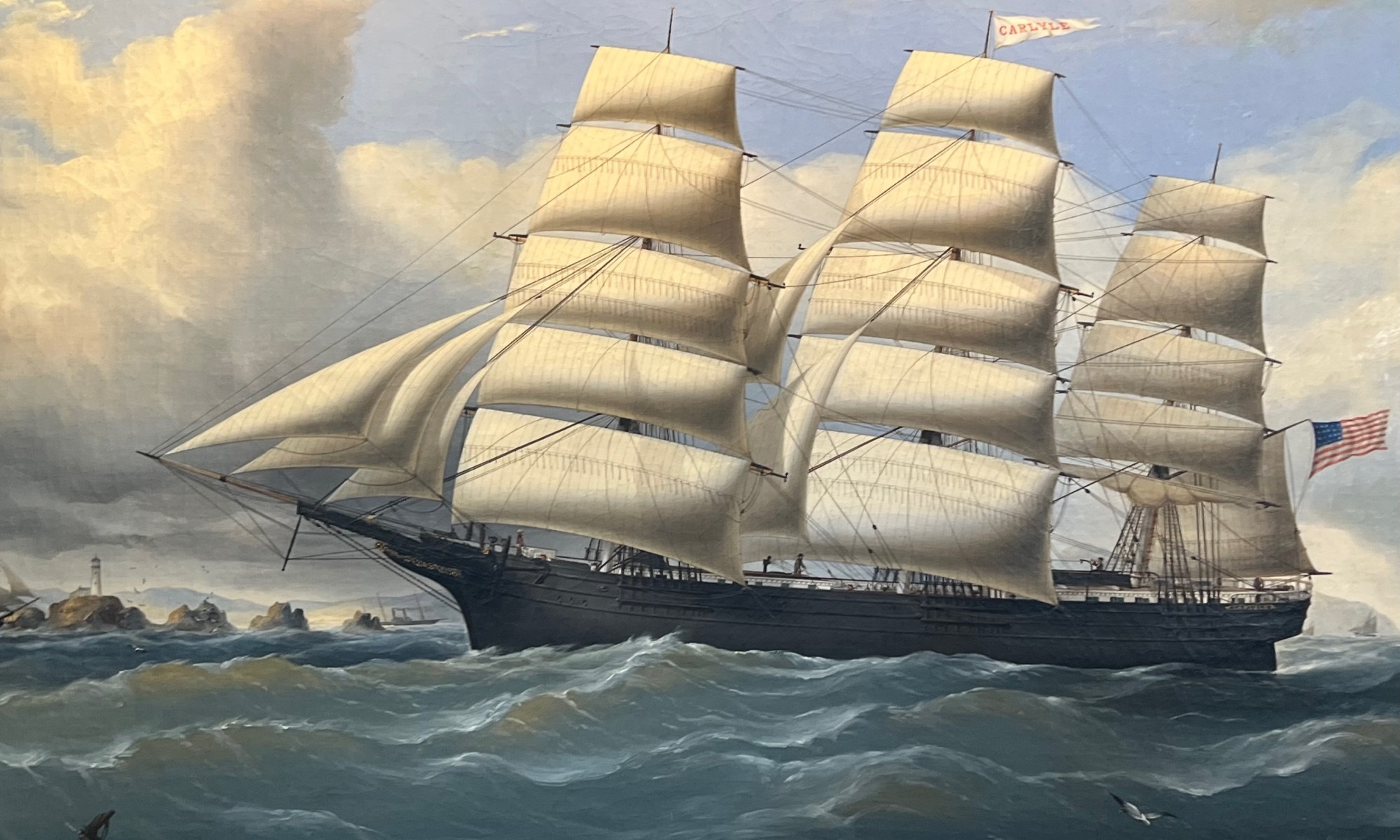
In the case of the current ship portrait, there is a lot of wood to be removed. The panel is eighteen inches by thirty plus. And a lot of that is background needing to be reduced. In this photo, most of the background has been removed, and I am taking out the background around and between the masses of the sails.

I took a long time sketching the lines for the vessel because I remained unsure of how much perspective and volume the carving would take. Better to procrastinate at that stage than when you’ve already removed a large volume of wood.

Somewhere after you’ve finished the chopping in, you begin to refine the shapes, and give a feeling of depth perception. There will be much more depth in this portrait than in most of my works. The ship is heeled over in the wind. As you look at it, the deck will be slanted in your direction, and the sails will be heavily filled and tilted in your direction.

After this ground removal work is done, the deck and bulwarks of the vessel can be defined and the sails shaped. All within less than a half inch in depth. Fun!

Here are a few of my other portraits showing how the process works out when done”

Decline & Fall – Ships Carving

A Golden Age

The gilt-edged age for the ship carver had to have been the 17th and 18th centuries. The figureheads were the least of it. There were gilded coats of arms, allegorical figures, swags, and elaborately carved moldings everywhere.
Set sail, wind up in a storm, get into a dust-up with the Dread Pirate Roberts or meet up with a French corsair, and when you came back into port, watch the carvers bill rachet skyward. Those cherubs on the starboard Quarter gallery? Somebody’s cannon blew away? They need replacing.


I doubt that carvers grew wealthy. But, there was steady work. Think of it as a handy 17th and 18th-century body shop for ships. “Here’s the estimate- we can try to save that Neptunas Rex on the transom, but it’s cheaper to replace.”
Sometime in the Napoleonic Wars, the British Admiralty began to budget the purse into which captains could dip for replacement swag. Just so much for a frigate, this for a fifth-rate, that for a third and so on. I’ve suspected that the Admiralty knew that some skippers and bosuns were in on a deal with with the carvers – ” I’ve got some cherubs this week buy them from me rather than Smithwick, and I’ll kickback 5%.” The fine art of naval chicanery in practice.
Thus began the inexorable decline and fall of the honorable trade of ships carver.

Things Change

Over on this side of the Atlantic, there were no royal purses to fund tons of gilded frippery. During the glory days of American sail, journalists would visit the docks and write a commentary on which newly arrived vessels were most tastefully attired. Many Maritime Museums display the fine figureheads that once graced the bows of the clippers.

Collection of the Peabody Essex Museum

Then along came the Quakers. They caused crews to mutiny by taking figureheads off vessels and replacing them with sober billet heads. Sail without our Jeremey Bentham figurehead? Never. Figureheads continued to have their day for a while. But, gradually, more modest accouterments became the rule. The cost was part of the reason; fancy carvings were expensive to maintain.
The following photos are from the U.S.S. Constitution Museum (for a detailed article on the Constitutions bow candy dip into this Article: https://ussconstitutionmuseum.org/2017/03/03/bow-decor/)

USS Constitution

The first photo came off the Constitution, and the second came from H.M.S. Cyane. Both are good representations of early 19th naval billet heads, spare and none too fancy. But, great representations of the carver’s art.

Two -headed equestrian figurehead from a Royal Navy vessel ( Peabody Essex Museum)

The Final Era

Compared to the two-headed equestrian figurehead ( circa 1750, in the collection of the Peabody Essex Museum), the billet heads appear downright dowdy. The final billet heads are from the Penobscot Bay Maritime Museums collection. They have the distinction of being in mint condition Carved by either Thomas or W.L. Seavy of Bangor, Maine. They never were mounted on a ship and represent the end of billet heads for commercial shipping.


Here is a shot of more recent work on a contemporary sailboat.

Lastly, here is a ridiculous bit of plastic on an otherwise pretty boat.

These days a Ships Carver may get a commission for a small billet head like the ones I carved. As shown in this photo:

Three carved wooden figureheads displayed on a table, featuring an eagle head, a stylized figure, and a detailed bird head, with a blue and white patterned tablecloth in the background.

But the bulk of the work is in quarterboards, transom banners and number boards. After I stopped doing boat shows I covered the walls of the porch with the samples I’d display. It gives a fair ide of the variety of wwork people would request.

Wooden plaques with names 'PEARL', 'NAUTILUS', 'CALTHOPE', and 'MANDALAY', along with carved decorative elements on a white wall.
a gallery wall

sic transit gloria mundi

Eagles

I once decided to carve ten eagles from variations on the same basic pattern. The 18th and 19th-century carvers had done it with eagles and figureheads. Small and large variations kept things distinct and interesting. An old favorite pattern would become dated, and the design would get reworked.

I could picture the scene in the shipyard’s office as a few of the locals gathered around the woodstove on a frosty fall day for companionship. The discussion was on the crass and revealing new fashions being requested for the figurehead design on the Tilly P, Arkham. Imagine that revealing bodice! What happened next is supposition, based on what I’ve seen in boat yards. Pencils and a piece of scrap wood came out, and rough sketches were drawn. Then there is a discussion of practical matters: how much to charge.

I decided to follow the lead of my predecessors and experiment.

The Eagles


I began with a photo of my favorite eagle at Mystic Seaport. The transom eagle from the first U.S.S Pennsylvania. I enlarged it to a size that I could use as a pattern, and from there, set about a two-year-long excursion into variations on themes.

In my first iteration, I found myself channeling a bit of McIntire as I played with the head. However, I checked myself short of going the McIntire serpentine neck route. I carved this one in a lovely piece of sugar pine, and the closeness of the grain allowed me excellent control of the tools. The movement in the legs of this eagle permitted me to create a sense of depth and movement in a piece of wood that was not that thick.


In the middle of the cycle of ten eagles, I channeled a very tiny bit of Bellamy with the head, neck, shelving of the upper wing, and banner. Anyone knowing Bellamy’s work, though, will recognize that he was an influence on my approach without any attempt to copy his style. It was just fun to acknowledge the master without imitating him. Made out of white pine, I gilded the piece, which I usually do only at the client’s request.

Eagle based on the transom eagle for the first USS Pennsylvania

The final eagle was a bit more architectural in approach. The head looks downward, and the body seems to be marching forward under a canopy of threatening wings. The wings were hollowed, giving the eagle an aggressive look. I had a piece of wood that could take bold carving, carved from thick local Massachusetts pine. Preparatory to gilding, I thinly painted with bronze paint. I liked the semi-transparent effect so well that I’ve left it that way.

Parting Thoughts


Boat shops are full of patterns with notes and measurements on how to alter the boat to the desired length, breadth, or other features. Mine is the same, and what I’ve seen from the remains of old-time ship carvers’ shops. The old-timers did the same.

The great martial artist Miyamoto Musashi said that from one thing, we could learn a thousand things.

Mix things up. Learn something new from something old.

Stream of Consciousness Saturday: Jokester

They were tiny hulls, hand-carved with small masts and yards—little clippers, frigates, and schooners. My father-in-law, the Cap’n, laughed and said they were toys. My first wife smiled adoringly at her father. Only my mother-in-law picked one up, held it under the light, and smiled encouragingly. But she said nothing. She never disagreed with her husband on nautical matters.

Then the Cap’n laughed, tossed the tiny hull back to me, and told me that it was a joke of an idea, and I should get serious about my carving.

Years later, a lady stopped by my booth at a boat show and told me she wanted a carving of her husband’s boat, an Eltro 19. I agreed to try the commission. When I got home from the show, I spent time thinking about how to proceed. My eyes settled on the one remaining little hull on the shelf. My mind started cogitating, and eventually I decided that a simple relief carving of the boat would do. It was the first of many boat and ship portraits.

I had hung on to the crude little hull not because it was a great carving, it wasn’t. But because it held the germ of an idea. It just took a nice lady looking for a birthday present to make the idea come into focus.

Definitely not a joke. Not all ideas spring full-blown from our minds; some have to develop slowly until they are ready.

Dreadnaught

Daily writing prompt
Tell us about the last thing you got excited about.

Excited? Well the other day I cleared the workbench of a small pile of small jobs that have kept me form startting work on mt portrait of the Clippership Dreadnaught. All I have to do now is vacuum and place the large wooden blank onto the cleaned bench and cogitate how to remove the rather vast amount of background.

It’s tempting to pull a router out- roooom, roooom! But you have better control of how the background will look when you do it with gouges. After all, part of it is the sea around the hull, and you need the contour to add depth and perception to the foreground. Also, I’d like to play with some contour in the sky with cloudscapes. Up to now I’ve painted the sky in, but how about carving the sky in? We’ll see.

So I’ll include a small gallery of some of my other work. Part of what I’ve grown increasingly interested in is the 19th-century diorama type of ship portraiture. The ship doesn’t just sit on the surface; it extends from it.

What I ‘ve done, to this point, is leave the ground flat, and allow the natural grin, and even defects, to suggest the active moving sky. So maybe I’ll allow some formations to protrude and suggest a bit more dynamic sky?

We’ll see. To a large extent, the wood dictates. Only in machine carving do you dictate to the wood. Sometimes the wood won’t take what you want to add, so a detail is excluded. But other times the wood allows you to do things you didn’t imagine possible. For the most part, I avoid metaphysical labels or descriptions for what I do. It’s a sort of tired pseudo-art talk. But the truth is that wood is a living medium, and we can manipulate it only so much before it rebels, breaks, or splinters. And that’s not whooe. Just ask anyone who has had a piece crack apart because they pushed the boundaries too far.

Carving is a dance with a partner, and partners always deserve respect.

Last on The Card- July, 2025

Here it is. The crew has been shortening sail in a big blow and it is not pretty:

A dramatic painting of a ship struggling in turbulent waters with partially furled sails, emphasizing the challenges of navigating a storm.

The foremast is already gone over the side.

Why did I take this picture? Because I carve portraits of boats and ships and sails full of wind are easy. But sails that are slack or partially furled have proven to be a challenge.

I spotted this painting at Newburyport’s wonderful Custom House Museum ( if you visit, make sure you take it in: https://customhousemaritimemuseum.org). The painting gives me clues that will help me carve sails with more complex wind dynamics.

Being a maritime carver means you never know it all. The sea always provides surprises.