
Sensei was fond of describing the arts of the sword as “fugitive.” By that, he meant that if not practiced, the accuracy of the skill would decline. And anytime work picked up and I missed practice or classes for a while, I found out exactly how right he was. A cut would be too low, too high, or not inside the targeted zone. The answer would be only practice and continuous application.
More recently, I’ve been playing the guitar again, and I realized that it, too, is a fugitive art. Strength in the hands is not like the old days, and accuracy in chording needs work. And so on.
Practice Makes…
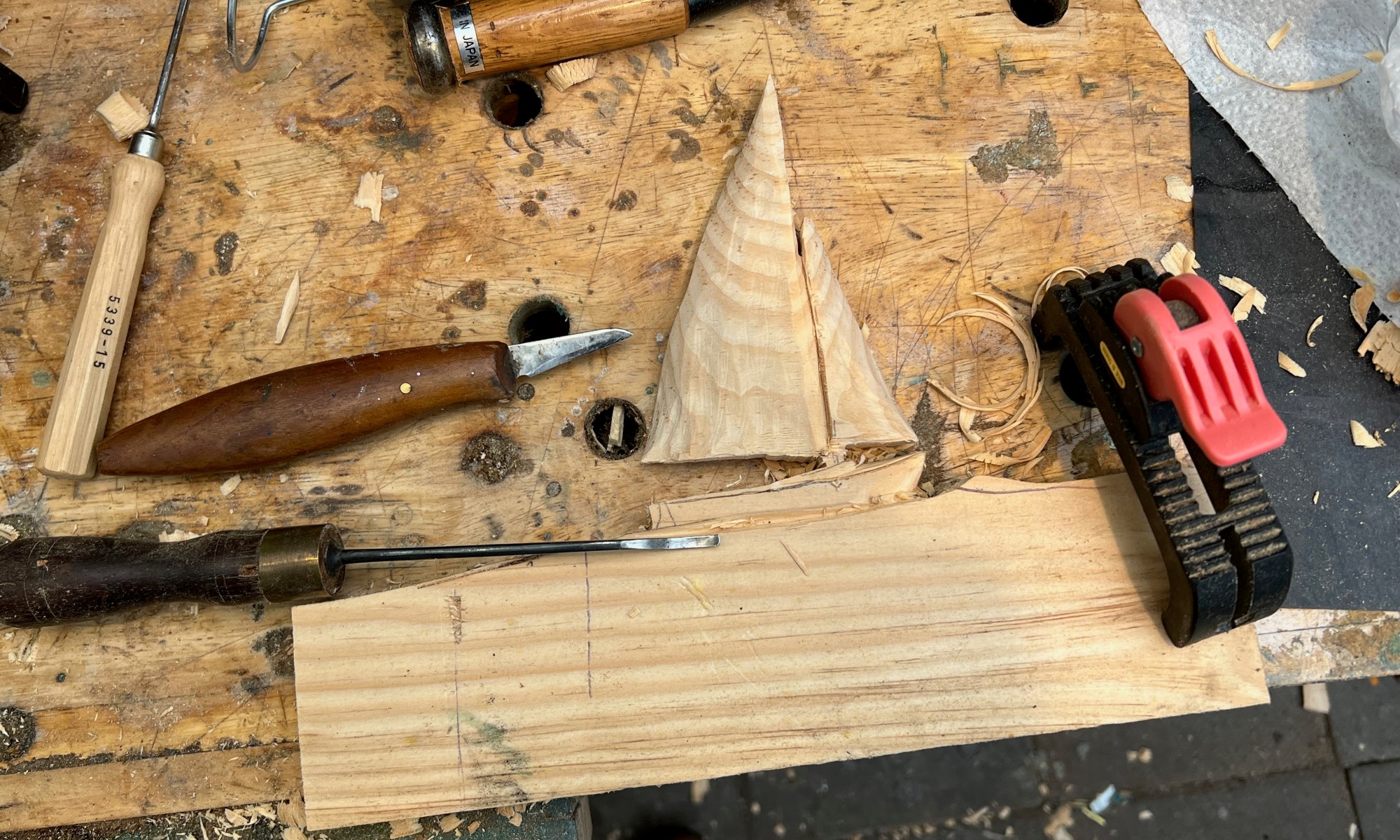
As of last week, I’ve started up in the shop again after only a brief pause. But having seen the results of a layoff in other areas, I determined to spend time on projects I haven’t had need to do for a while. I’ve mostly been doing boat portrait work. Not a lot of work has come in for lettering, chip carving, or general relief work, so in January, those are the areas I’ll start working on in addition to the portrait work.
It’s too easy to describe foundational work as a rote technical performance. Correctly used, they are conditioners of our physical techniques. In chip carving, for instance, they help us develop precise cutting techniques – delivering a needed cut at an exact angle. It’s a skill that is as useful in cutting a rosette as it is in detailing a sail on a portrait of a schooner. And it’s only achievable through practice. It’s not something that you can will into existence by acts of persistent imagination.
Another bit of this is that sometimes the basics expand our horizons. I was never keen on chip carving until I was marking time over my government layoff during Clinton’s “Reinvention of Government “(so-called!). My stress levels were through the roof. I made a small carving kit of some slip-resistant padding, two chip carving knives, and some small pieces of wood. It all fit into a cedar cigar box. I could take this anywhere ( well, other than an airport) and spend a lunch hour creating some small piece of chip carving. It considerably relieved my stress and taught me things about carving I had never known. It entirely changed how I carved letters.
On the Other Hand…
Artists who lay off art and musicians who spend time away from music sometimes admit to a refreshed interest. After all, what we do is not just mechanical – it’s not like changing a tire on a car. The mechanics are crucial, but the attitude we bring to the work is what makes it live. In that way, a period of laying can be time well spent when you begin again refreshed and with a bit of a new perspective.
If only we could learn to balance the two opposing effects.
Discover more from Louis N. Carreras, Woodcarver
Subscribe to get the latest posts sent to your email.
I’m reading contest books right now and not painting. It’s OK since, at the moment, I don’t know how I feel about anything and the books are a good focus.
You’re not missing out on anything good on the news, Martha. It’s all awful.
Not surprising… 😭
👍👍👍