
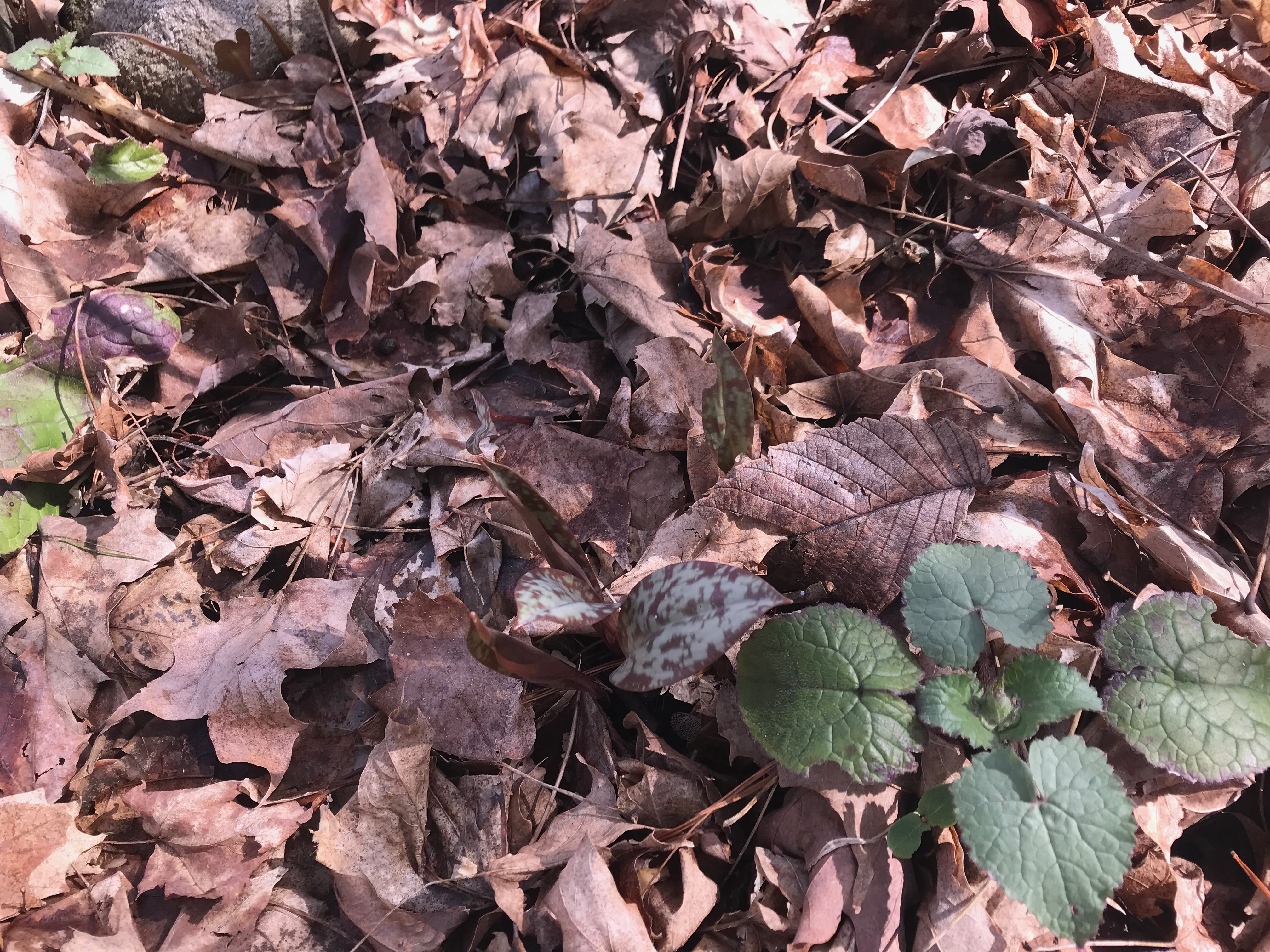
The other day, I was talking to the conservation agent in the town where my Access TV station is located. We were talking about springtime ephemeral flowers. It’s the time of spring when we wander the woods looking for the first trilliums, bloodroot, and trout lily flowers. It’s fun to get out into the woods this time of year. The birds are singing, and spring is almost more of a myth than a thing. The maples are just beginning to bud, and despite the sun, there is a chill in the air.
I was reporting that the bloodroot and trout lily leaves were out, but no flowers were evident. Around this time, the rest of the people in the room began to tune us out as we drifted into a discussion of soil regimes, canopy dominance and the importance of ephemerals to early pollinators. Our discussion had drifted from the vernacular into the specific language of forestry and conservation.
We talked about site specifications, snag trees, cavity trees, the number of ten- and eight-foot logs, and the DBH ( Diameter Breast Height) of trees. Then we moved on to talk about canopy trees, sub-dominant species, and suppressed species—you know, the sort of funky stuff people in forestry are savvy about. Forest communities are not random; there is a strategic relationship of species as a community.
How did I, an anthropologist, former Pius Itinerant, and folksinger, know this stuff? Well, back before being dastardly expelled from the George Washington High School in New York City, I had dreams. No, not dreams of playing in coffeehouses and bars or being an anthropologist. I dreamed of being a forest ranger, timber cruiser, or such.
What is not commonly known to people outside of New York City is that Central Park is not the only well-wooded area. There are lots of woods in northern Manhattan and the Bronx. I was well-traveled along the trails of those woodlands and knew quite a lot about them.
One day I was standing around talking with a bunch of friends when an older brother of a friend joined in. He was a recent graduate of the Forestry program at Syracuse. Finding this out, I began to pummel him with questions on the identification of different Quercus species ( oak), which I was having trouble with. After a while he told me to wait, and went into the apartment house. He returned a few minutes later with the 1958 edition of the Textbook of Dendrology. George let me take the book, and I never saw him again.
Later that year, the die was cast on my future. I was expelled, and my dreams of going to forestry school ended. That fall, I was in the Village performing, and in the spring of 1965, I hit the road to New England.
Buried in the bottom of my pack were a few books still in my library all these years later. One was the textbook of Dendrology. It came in handy. I’d be passing through a spot, and have to make camp. Out would come the book on dendrology, and the other books on woodland plants. I’d be occupied classifying the species next to my campfire.
Thanks for the gift, George W. Scot!
Discover more from Louis N. Carreras, Woodcarver
Subscribe to get the latest posts sent to your email.
I wanted to be a forest ranger, too. The gubmint made me take an aptitude test before college since they were paying my way and turned out that was my strongest aptitude. My mom had a stronger aptitude and as Journalist was also high on the list, she and the gubmint counselor agreed I’d be a journalist. She imagined me on TV. I imagined me on the royal road to romance in faraway countries talking to world leaders. That woman and I had many conflicting visions who I was as a person. Happily, I’ve kind of gotten to be a forest ranger and I’ve done a little journalism here in the Bark of Beyond which is pretty wild and woolly. 😀
Our true natures find a pathway to freedom.
Absolutely. No way was I going to be an artist, an Olympic runner or a forest ranger. Oh yeah?