
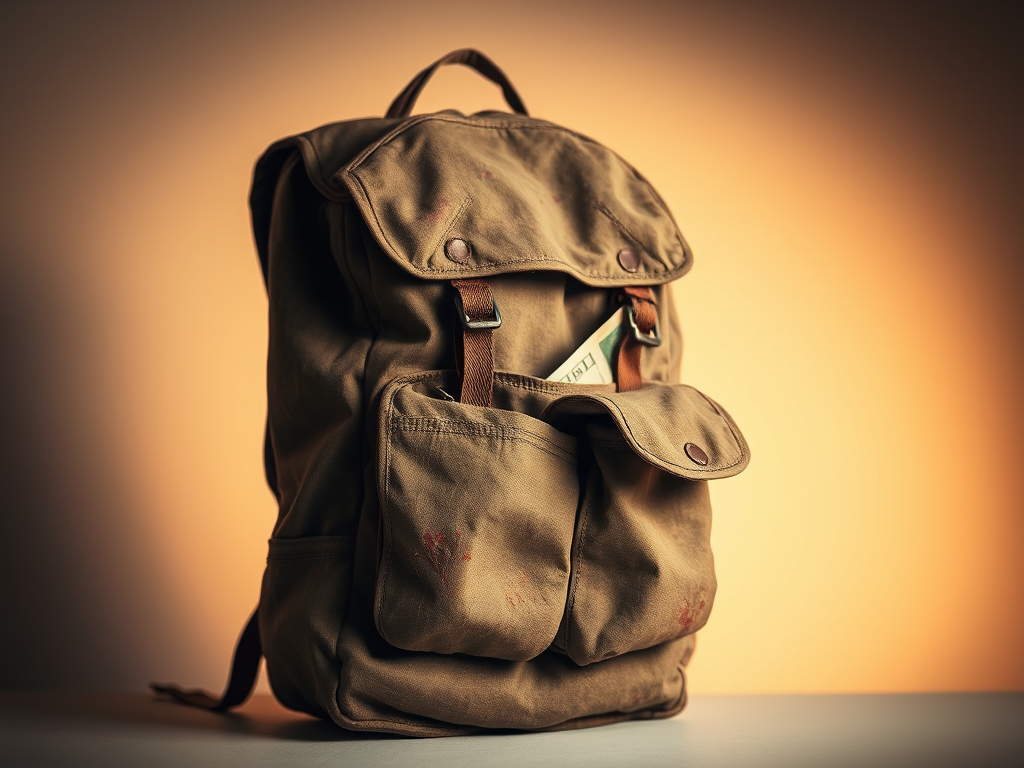
There is a lot of romanticizing about being on the road. And Jack Kerouac’s book On the Road is responsible for lots of it. The Romance of the Road? You bet.
Having been on the road myself for several years, I found familiar passages and events in it that I found reflected in my own life. But I didn’t read the book until years after I left the road and settled into life as an older returning student. A teacher, knowing of my time on the road, suggested it as a reading. It did make an impression, but not necessarily a great one.
To pay full service to the book, there was twenty or so years’ difference in the experiences. I was on the road in the sixties and early seventies. The circumstances had altered a lot. Also, my personality was vastly different than Kerouac’s. Things he focused on, I ignored; and no, I’m not diverging into a discussion about that.
But my main complaint is not with the book, but with what people did with the book. It became “The Road” to lots of wanna be’s. People who’d hitched between Paramus and Newark now thought they had had a transformative experience on the road. To give full service to the concept of being on the road this just does not cut it.
After knowing me for a full half hour at the party, a girl put down my travels as being inconsequential because I was not a Beat, and had never met Dean Moriarity. Sitting in the back room were my backpack and guitar that had just gotten in from a thousand miles of thumbing on secondary roads, highways, and breakfasts at small town diners, soup kitchens, and snack bars eaten by the side of the road. I listened to her spout this nonsense with real disappointment – she’d seemed so interesting up till that point.
After sleeping on a couch with sprung springs that stuck into me, I undulated down the road the next day for the final leg of my trip back to Boston, about six hundred miles. In the three days of that haul, I played in two small church-run coffeehouses, washed dishes, mopped floors, and smoked some world-class weed with a friend in Baltimore. The friend in Baltimore’s girlfriend worked at the Walters Art Museum and got me a private guided tour – not too shabby.
The book is not the experience. Regretfully, many people can’t separate the two. But reading is not experiencing, and many of the stay-at-homes should do just that. They don’t have it in them.
It’s not all glory, folks! Those nights spent in the woods eating beans warmed up over a tiny fire, or running from the teenage thugs who want to steal your pack, guitar, and last five dollars. Yes, there are peaceful experiences at dawn, looking out over a mountaintop to a valley. But two hours later, you are trying to convince the local Officer Opie that you are not a threat to the safety of the little hometown.
You see, it’s not all that romantic.
Now, in a shameless plea to introduce you to the realities of Pius Itinerancy, here is a link to one of my stories. Enjoy!


Discover more from Louis N. Carreras, Woodcarver
Subscribe to get the latest posts sent to your email.
I read On The Road many years ago, as a teenager. Probably beause it seemed everyone was reading it, althugh Keroouac died in 1969,. You article has reminded me to do a reread. At the age of 80 I might discover more in the book. My experience with the Beat Generation would probably be revised today.
I knew Beats in the Village. I think the popular image is exaggerated. By the way the book by him that I truly enjoed was the Dharma Bums!
I loved the Dharma Bums!!
Best book he wrote. I need to put it on my list to read again.
What about The Hitcher, then?
There were creeps on the road, but that film spread terrible images and gave some people excuses for crimes against innocent hitchhikers. Sensationalism at its worst.
Yep. Not pleasant. I remember it even from 40 years ago.
I don’t think I’ve ever heard of this book. I think I’ll look it up and give it a read. I never went far away from Buffalo until I was in my 20’s, and then it was in my own car. Reading your stories is a good trip for me. Thanks for sharing all your memories.
A pleasure to share, Alice!
Good memories always hit differently.
I think it depends what a person is looking for in that book. The reader is at least 50% of the content of any book. From what I know of you and your experiences on the road, I don’t see any similarities between you and any Kerouac character. I don’t think you were looking for God or trying to make sense of civilization that had just bombed the shit out of Japan. I don’t think you were attempting to be a literary hero. You were a musician and your scene was completely different as was your era. IMO, anyone who recommended that book to you saying you’d relate to it? No…missed the point of the book and possibly missed the point of you.
I liked what Burroughs said about Kerouac, “Kerouac is a writer, by that I mean, Kerouac writes.” That’s a pretty solid definition, IMO.
There’s a lot of self-indulgent naval gazing in all of Kerouac’s books, but when he turns outward, there is some beautiful stuff in there. As for overrated? I don’t even know what that means. For me it all comes down to personal taste, maybe an intellectual mud bath, or a moment in life when the book will resonate.
A lot of my international students came to America because of that book and they wanted to go “On the road.” It was hugely inspiring to them.
I didn’t even read it until I was nearly 40 and I kind of liked it. I could definitely see its power to inspire people at a certain moment in life. Kerouac rightly said, “99% of Americans attempt to solve their problems by going on the road.” Revealing, I think, a little cynicism about his own experiences. I don’t know that he found the redemption he was looking for. I don’t think so.
Living in Denver as I did, and not having read the book? Actually kind of funny. The part of Denver that features in the book really was what he described. I don’t know if it remained that way, but it held onto the vibe a long time. In my 20s, had a boyfriend-like-thing from Philly who wanted me to show him Kerouac’s Denver and I knew nothing about that. “How could you not know?”
When I read the book some 20 years later, and, in the story, Kerouac arrived in “my” world (west of the Missouri River) I thought he only saw what he expected to see — Cheyenne Frontier Days, Denver as a wild-west town — stuff like that. By then I lived in California…
I’ve taught kids from the East Coast who were legitimately disappointed that there were no cattle drives in downtown Denver.
In a way, I think we all want to validate the mystique, and maybe when we’re young and haven’t tested the water, we have more theories about ourselves than we have facts. That book is not for people who’ve moved beyond a mirror, been kicked in the nuts (figuratively or literally) and have learned that reality is a better place to be than illusion.
Your reply to my post is a great post in itself, Martha. And you made some great points about what he and I were looking for. Regretfully, he found his answers at the bottom of a bottle, as I almost did too. It was a sad end to a great talent. I worked in Lowell, Mass, where the Keruacian capitalists revere him, and make money off his memory. I found it kind of Ghoulish, and just plain sick. There is even a family foundation licensing merch.
WP just gave me an award for my response to your post. It’s the “Got Carried Away” award for writing a comment longer than the original post. What a riot. And yeah; Kerouac threw himself away. He should have kept his hiking boots and gotten a job in the Sierras with Japhy.
Wait… they gave you an award? Really?