
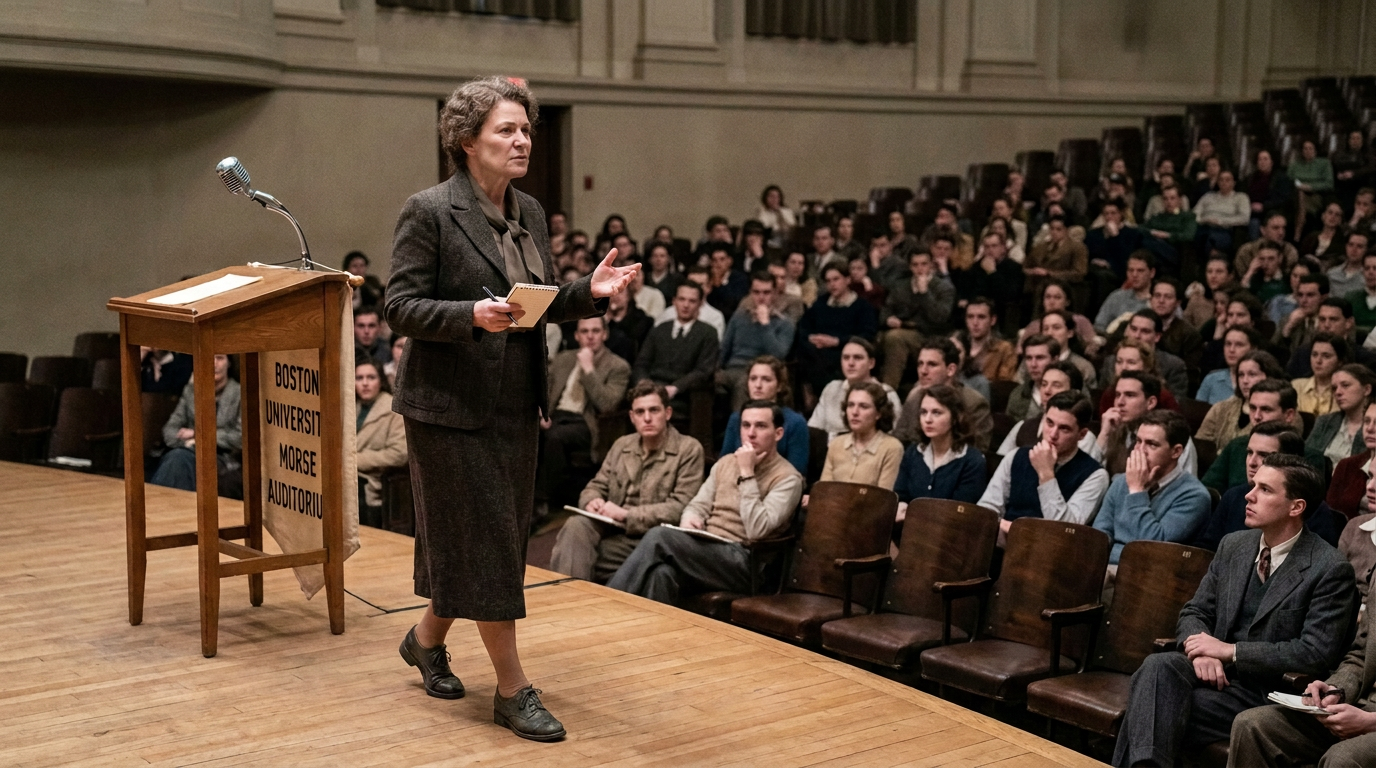
It was just good fortune. I was a high school evictee, second-rate coffeehouse performer, retiring Pius Itinerant, and there I was a student at Boston University’s Metropolitan College. I was the boy turned loose in the candy shop after hours.
I had engaging, and sometimes madcap, professors who believed in exposing their students to the widest range of cultural and educational topics. There was Elizabeth “Ma” Barker pacing the stage of Morse Auditorium, introducing me to the wonders of Gilgamesh, Gogol, and Voltaire in a string of wide-ranging courses. Then there was the savvy Yugoslavian political science professor who’d been an aide to one of the top figures in that nation’s formation. His specialty? How things got done behind closed doors.
It seemed that every semester some new theme was introduced that exposed me to new worlds.
The Spanish teacher, whose fascination with the work of Luis Buñuel extended to in-class showings of Un Chien Andalou and Viridiana, was the best example. He felt that an education in the Spanish language was best complemented by a broad immersion in Spain’s cultural and artistic heritage. And he was a huge fan of Dalí and Buñuel. Un Chien Andalou is one of the strangest films I’ve ever seen. But it was an important part of the total educational experience. Every life needs a bit of the surreal to perk it up, after all!
An education can be rated on the basis of what sticks. And frankly, I’m a bit of an educational snob with a difference. I feel that you can get an incredibly valuable education at a community college or an Ivy League institution. It’s a matter of what you do with it, and how widely you are exposed to that hoary old concept of a liberal arts education. Exposure to all that other stuff, not in your major, will be what bails you out when your main field goes technologically obsolete or is too crowded to support one more Cubical Systems Analyst. It’s then that you deduce that all that “other stuff” had value, if only of a non-tangible nature.
So those memories of Ma Barker pacing the stage and elaborating on Euripides, or the back room deals of Milovan Djilas after the Second World War in Yugoslavia, and Un Chien Andalou are a perennial source of inspiration, and sometimes even practical knowledge.
What’s the weirdest movie you’ve ever watched?
View all responses
Discover more from Louis N. Carreras, Woodcarver
Subscribe to get the latest posts sent to your email.
Yeah, I firmly believe the main thing higher education will teach us is how to absorb information, just generally. How often does a graduate enter their first job, only to realise that they know nothing? Any yet the employer will hire them on the basis of what they will be able to learn.
Great observation.
Euripedes Eumenedes:) Ancient History School Teacher. She used to speak in Latin to us . Sedete in silencio. Still remember her.
You were so fortunate being exposed to these wonderful eccentric teachers at the tertiary level I don’t know if this a usual experience in America but it certainly is not in Australia. ….Rall
I’m not sure it is encouraged nowadays. But I think that is invaluable.
By the way, thanks for stopping by ad reading !
Gilgamesh. ❤️ I was always having to persuade some student that a liberal arts education was more useful than they could imagine while they were in school with their one-track minds, focused on a “degree” a career and a “future.” That future is really really long and there’s so much more in it than a “career.”
I think part of the problem has been people go to school directly from high school. High school is not good preparation for life or college. Met College has often been described as being for second or even third chances. Women and men that have already experienced a bit of life.
I would never generalize this. I taught four generations of kids. That right there meant that the people who appeared in my classrooms had very different preparations, the school systems in those generations varied widely, the basic backgrounds and educations of their teachers was all over the place. I taught kids from our Generation all the way to Gen Z when I retired. They’d grown up in different worlds. I’d add to that parents. That’s an infinite variety right there — how and where did they grow up? Did they have a shot at an education? My parents were both college educated, but one grew up very poor on a dirt farm in Montana during the Depression; both had lived through WW II. That right there is crazy. They were both very literate, loved to read, loved poetry. I think that was an advantage for me but not for my brother. He had major behavior problems which now would be diagnosed and treated.
By the time I left teaching, publishing companies were making bank on textbooks that were essentially scripts for teachers and everything — including answers to questions — was online and students could find it. In pre-semester meetings at the community college where I had a couple classes we were encouraged to use these egregious sterile evil things. A teacher like me no longer had a place in any school where I taught. I was an obsolete tool. OK. Welcome to the machine. The best generation I taught was Generation X — they were risk takers which meant they were ready to learn.
Martha, I wrote my comment before I read yours. Aha! I am Generation X. Maybe my approach to learning was common after all. But I remain grateful to teachers like you and the ones who taught me.
Gen X was — for me — the most fun to teach. Challenging in a good way. I still occasionally hear from a few of them and I’m very proud to have had a little role in their lives. Besides, your generation’s music really is the best.
I loved teaching my nursing students. They were so well-grounded, but not overly serious about everything.
Their future patients were lucky!!!
Damn! I remember one of those textbooks! It was so dumbed down; it was incredible. And talk about something designed for a multiple-choice exam!
They were exactly designed for multiple choice exams. My last class? An unspeakable horror. I cam into direct contact with 25 students in summer lit who thought they knew everything because all they’d known were textbooks like that. I even got in an argument — not really but something — about whether Greek is or is not a dead language. That little MOFO was sure he was right and I had to prove him wrong! Seriously. He challenged me. Unreal. I didn’t even give them a final exam. I just showed up for the last class with cupcakes and left after 30 minutes. I knew I couldn’t teach any more because I had nothing but contempt for the 25 people in my classroom. One kid hadn’t done his homework. It was a worksheet I’d put on the Blackboard site. He said, “I’ll get it online later.” He didn’t mean our class’ site; he meant Google. I just said, “OK. Good luck.” I did not add the two words I wanted to, one a word referring to a family member. THAT’S what those textbooks and NCLB did to intellectual curiosity and respect for teachers. BUT I figure in 38 years in the classroom, ONE class like that doesn’t even matter.
The horror of that form of “education” is that when the shit hits the proverbial fan, it not only sputters the idiots who bought into the myth that they received an education, but it weakens and debilitates the entire society.
Exactly. You just have to hope they got knocked upside the head in their first job. There was a bright spot in that class. My African American student wanted to know more about the Civil Rights stuff in the 60s. I showed them films of demonstrations and marches. At one point she stood up and said, “White people joined in? I didn’t know! Why?” I thought my heart would break. I t was a composite of shots from the march from Selma to Montgomery. The kid who didn’t know Greek is a living language? When I told him I’d studied Greek and then said, “Work!” and started to walk away. He asked his classmate to look up the word for “work” in Greek on his laptop. “Can you read that?” “Sure,” and I did. He asked his friend to playback the pronunciation on the translator. His jaw dropped when he heard that I was right. I said, “We use that word. You know ‘ergonomics’? Greek is all over the place.” And I walked off. Teaching and learning are messy things. That kid learned a LOT that day.
Evidently, multiple choice became popular after IBM made the results easily punched into Hollerith computer punch cards, allowing the results to be rapidly tabulated and analyzed.
I don’t have a problem with multiple choice. They can be good exams, but they’re only going to be as good as the person who writes the tests, and publishing companies should not be in charge of that. They should never be used to evaluate the ability of a student to reason and articulate his/her reasoning. They can’t measure that. They also reduce everything to a grade. The Scantron company actually GAVE schools the scanning devices. Talk about “first time free”… 🤣💉
I have an immediate answer: the film that the more modern movie “12 Monkeys” was based on. I thoroughly enjoyed 12 Monkeys, but it was inspired by, and uses ideas from, Chris Marker’s 1962 French short film La Jetée. A friend had the movie and sent me the file so I could watch it.
I had wonderful teachers in high school. Not eccentric, so much as deeply invested and caring people who are the main reason I became committed to more education. I was always asking strange questions and wanting to do something different than everyone else in the class, and pushing things beyond their intended purpose. Multiple teachers let me do it, and I had permission to do my own work for class credit in multiple classes for multiple years. I am sure the overburdened teachers of today would not be able to accommodate my spirited approach to learning.
They might — but remembering my younger colleagues, their training was different than that of teachers of yore. And the whole shift to multiple choice exams as a measure of learning changed things a lot — not in a good way. It made consequences for risk-taking dire. Fail exams, forget graduating, forget university, forget a future. My students (university) were terrified to be wrong. No one learns anything if they’re terrified to be wrong. So, maybe not. The two generations immediately before Gen X emerged and grew. up in times of rebuilding and innovation. I can’t say I know this for sure, but I believe it supported a culture of inventiveness. Just my theory. You must have been fun to teach.
When I moved from the Metropolitan College to the College of Liberal Arts at BU, the undergrads were all out of high school directly, not second-chancers. This was about 1973, and the difference was palpable. But I can’t speak to what might have been the case across the river at, say, Harvard.
I think the bar of higher education in thus country has been dangerously lowered in recent years. Instead of being taught critical thinking and how to absorb information, the goal has become memorization and blindly accepting the whitewashed history if the current conservative narrative while banning or denying D.E.I.
I agree, but I think everyone is running scared that their institution will be investigated; it’s like the McCarthy years all over again.