

I once decided to carve ten eagles from variations on the same basic pattern. The 18th and 19th-century carvers had done it with eagles and figureheads. Small and large variations kept things distinct and interesting. An old favorite pattern would become dated, and the design would get reworked.
I could picture the scene in the shipyard’s office as a few of the locals gathered around the woodstove on a frosty fall day for companionship. The discussion was on the crass and revealing new fashions being requested for the figurehead design on the Tilly P, Arkham. Imagine that revealing bodice! What happened next is supposition, based on what I’ve seen in boat yards. Pencils and a piece of scrap wood came out, and rough sketches were drawn. Then there is a discussion of practical matters: how much to charge.
I decided to follow the lead of my predecessors and experiment.
The Eagles
I began with a photo of my favorite eagle at Mystic Seaport. The transom eagle from the first U.S.S Pennsylvania. I enlarged it to a size that I could use as a pattern, and from there, set about a two-year-long excursion into variations on themes.
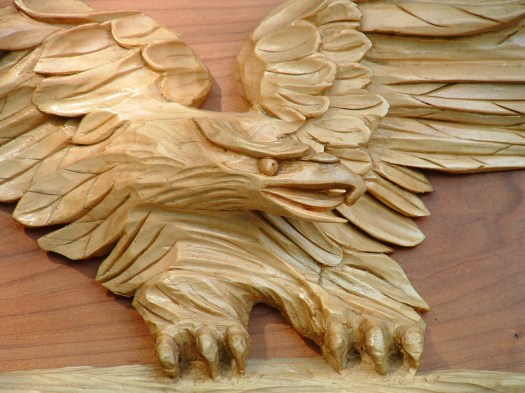
In my first iteration, I found myself channeling a bit of McIntire as I played with the head. However, I checked myself short of going the McIntire serpentine neck route. I carved this one in a lovely piece of sugar pine, and the closeness of the grain allowed me excellent control of the tools. The movement in the legs of this eagle permitted me to create a sense of depth and movement in a piece of wood that was not that thick.
In the middle of the cycle of ten eagles, I channeled a very tiny bit of Bellamy with the head, neck, shelving of the upper wing, and banner. Anyone knowing Bellamy’s work, though, will recognize that he was an influence on my approach without any attempt to copy his style. It was just fun to acknowledge the master without imitating him. Made out of white pine, I gilded the piece, which I usually do only at the client’s request.
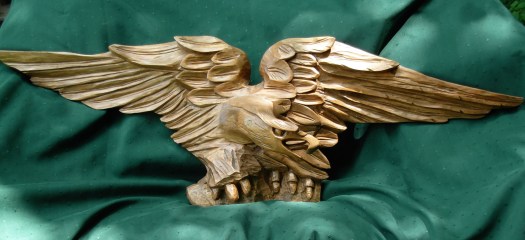
The final eagle was a bit more architectural in approach. The head looks downward, and the body seems to be marching forward under a canopy of threatening wings. The wings were hollowed, giving the eagle an aggressive look. I had a piece of wood that could take bold carving, carved from thick local Massachusetts pine. Preparatory to gilding, I thinly painted with bronze paint. I liked the semi-transparent effect so well that I’ve left it that way.
Parting Thoughts
Boat shops are full of patterns with notes and measurements on how to alter the boat to the desired length, breadth, or other features. Mine is the same, and what I’ve seen from the remains of old-time ship carvers’ shops. The old-timers did the same.
The great martial artist Miyamoto Musashi said that from one thing, we could learn a thousand things.
Mix things up. Learn something new from something old.
Discover more from Louis N. Carreras, Woodcarver
Subscribe to get the latest posts sent to your email.
You have great talent!
Thank you!
Love them, particularly the last one with the green background. It means business. As Alice said, you are so talented. And hardworking. I know how much sheer persistence goes into the final product.
Thanks, Tracy!
WOW! Great art work. Thank you, Love, nia