Eagle Heads

Figureheads get lots of attention in maritime museum exhibits. There are even museum collections of figureheads lost at sea. Often, the names of the ships they graced are unknown. If we knew, we could reconstruct a travelogue of all the ports they’d seen.

But many ships lacked figureheads. The old figure went overboard in a storm, or if the owners were Quakers, religious sentiments forbade a figurehead. In its place, a billet head—a bit of fancy carved scrollwork with a small bust or other ornament on top—was used.

While I love figureheads, I’ve never seen the business interest in carving them – much too restricted as a trade. Instead, I’ve carved small billet heads for the sort of small vessel that could sport them these days. Many of the ones I’ve carved hold up signs, grace entryways, or act as bookends. Billet heads are attractive and we can size them for smaller vessels, boats, or home use.

The photo above shows a sample of the billet heads I’ve carved. The green scroll was the first one I did. I simplified my version from a traditional design Jay Hanna carved. The three eagles are of my design but modeled on traditional 19th-century styles. My favorite is closest to the viewer. I carved it in western sugar pine and made the mounting element from mahogany.

The eyes on the eagles are the most essential part of the carving. The feathers look complex but are pretty simple. Get the eyes right, though, and the birdie seems to follow you about the room, casting a gimlet eye on your doings.
Better behave. They see everything you are doing – in jest or earnest.

More on Tools

In the 19th and early 20th centuries, a Drummer was not just a percussionist. A drummer was a traveling salesman who’d make the rounds with tools, clothes, or anything else you might wish to purchase but could not easily find at the small retail establishments in your town. Think no internet, no Walmart, and few large department stores.
Now think about trade carvers; that’s right, there were many of them. They designed and made patterns and signs and carved the furniture decorations one at a time. Anything to be cast, machined, or reproduced required making an original master, and the carver was the individual who did that. With a good number of craftspeople to serve, there were tool makers who catered to these specialists.

The photo shows a collection of tools I am using for some tight recess carving on the jib sails of the ship portrait I am working on. The tools are primarily tiny back bents and knuckle tools that will fit into tight recesses. There are only a few manufacturers of these today, and I don’t like the design of their tools. So I purchased, for short money, this batch of C. Maier tools. The company was in business from about 1880 to maybe 1928 in Newark, NJ. Most of the tools I’ve seen that they produced are like those I bought – back bents, knuckles, and fishtails – good tools for working in recesses or miniature work.

The ones I purchased were in amazingly good shape but well-used. The carver who owned them before me was likely not their original owner. They are good tools that have lasted through at least three owners.
Nowadays, I go to a tool retailer and order online, but when these tools showed up in their first owner’s shop, that was not possible. Without the World Wide Web or specialty tool stores, they might have mail-ordered from a catalog or had a visit from a Drummer who would have shown them the tools, let them handle them, and taken their order.

Special needs are why carvers wind up with racks of tools, not a sort of wild tool lust.

OK, I’m lying. It’s a necessity, but also tool lust…I need a twelve-step program.
Hi, I am Lou Carreras. I’m addicted to buying tools.

Mastery

Yesterday, I spent a significant part of the day working on a carving of a large schooner. I based it on research I did for an earlier schooner built by the same yard around the same time in the late 19th century. 

I used skills acquired in the earlier carving to ease the work on the sails’ design. The sails on a vessel like this are most of what you see. So having their contours “look” right, not just be shaped “right,” is critical. After finishing the earlier carving, I spent time analyzing the degree of satisfaction I had with design execution. There were places where my techniques failed to give the correct effect on the jib sails. How I added the masts also looked like a very inadequate paste job – they needed to be proportioned correctly.

So, I figured out a better way to cut in the background around the jibs’ tack . They’ll look crisper in the carving, now. Next I’ll be experimenting with how the masts are tapered and colored ( very lightly). My skill set as a carver grew.

Now for the rant part of this post. Anyone who’s been involved in a quality control process or recognizes the term Kaizen will understand what I am about here. As an artist or crafter, I am not static. I don’t just have a standard job that I repeat infinitely. This is what I have against the concept of being a “Master.” The term carries more than a hint of being a survivor of a race to a pinnacle – a point of stasis. Stasis is precisely what I do not want in my work.

I recollect watching seventh and eighth-dan sensei (seventh and eighth-degree black belts in Japanese swordsmanship) gently pointing out flaws in kata to one another. Even at their degree of mastery, there was room for improvement. That’s the sort of mastery I aspire to – skill sets and concepts of working continually growing.

In art and craft, mastery is a moving target, which is healthy.

Daily writing prompt
What are you good at?

A Birchwood Bowl in process

Photographs help me remember steps and processes. Years ago, I used photography only to record the results. But pictures of the in-between stages were more than a bit helpful. One of the big reasons I say this is because there are some things that I only do rarely. Reminders are valuable.
I need to be a better journalist. I may or may not have a series of notes on processes, like how I finished a particular project five years ago. If I have not, then a photographic record helps to prompt memory. In the case of this bowl, I have a short series of shots.

Prominent in some of these photos is the gooseneck scraper. Why? Because a well-sharpened and burnished gooseneck is the most effective tool for removing the rough marks and scratches of earlier gouge and sanding work. The temptation is to sand it and forgo the scraping. However, the scraper saves labor and reduces the amount of sanding required.


In the above photo, the bowl has reached the stage where the interior, the most challenging place to finish on a small bowl, is almost done. I’ve given it a first coat of a food-safe varnish to see the grain of the soon-to-be-finished bowl. The finish also reveals the spots that are still rough.

I made this bowl from a piece of birch I found in my pile of firewood. It had nice grain and was deep and wide enough to create a pretty bowl. As firewood, I find birch only so-so. But I am always scouting the firewood for material that can be up-cycled into valuable things. Hopefully, someday, someone will prize the little bowl and find pleasure in running hands along its contours and gazing at the twists in the grain.

The Woodcarver and the Sunk Cost Fallacy

If you studied economics, process engineering or are an enthusiast of popular psychology, you might have heard of the Sunk Cost Fallacy. It’s alive and well in woodcarving too. Sunk costs are costs you have paid and can’t get back. 

That’s fine if everything works out. But if the project just hasn’t been the success you wished for, the temptation is to keep trying to fix it. Sometimes it can’t be fixed. And that’s the sunk cost fallacy: The belief that just one more project revision will allow the Goony Bird Mk 29 to fly.

I knew the fallacy well. I called it “just one more cut.” The piece will work with one more cut to clean up that angle. Five cuts later, the chip carving is worse off than when I started. I was most familiar with it from chip carving because some of the balance and symmetry of a piece come from all cuts sharing similar geometry; if one facet is out of balance, the carving looks odd.

I saw it a lot more when I started teaching. I start my courses with chip carving to teach tool control and the importance of sharp tools. An occasional student could not stop cutting and adjusting. Rarely did any of this result in a saved piece of work. I described it to my students at WoodenBoat School as “just one more cut.”

Later, over dinner, an engineer in my class told me about the sunk cost fallacy. As I write this, I can think of an eagle I’ve carved that I’d love to take one more cut on. See, it’s pervasive.

Here’s some advice I’ve offered that applies well here:

  •  First, turn the carving bottom for the top; how bad is the perceived defect? 
  • Second, using a hand mirror, view the work from various perspectives; once again, how bad is the defect? 
  • Third, put down the tools and work on something else for the rest of the day. Come back later. 
  • Fourth, study the effect of the corrective cut before you do it. What are the chances of that cut fixing the problem? 
  • Fifth, when realizing you’ve wasted hours mulling over ten minutes of carving, throw the junk into the kindling bucket and do it right. It’s harder to do the further along the piece is; I’m not telling you that I have no struggles with this.

So, Robert Elliot, a colleague of mine who produces gorgeous Windsor chairs, once scolded me that we can’t just throw everything that had a mistake away. We have to learn how to fix errors. That’s the value of the first steps, knowing what we did wrong, thinking about how it can be fixed, and evaluating if it’s worth fixing. Hopefully, we will learn enough to avoid repeat errors and the frustration of endlessly falling into the sunk cost fallacy. 

Zaida “sits” for her portrait

Although the steam yacht Zaida sits within the frame on the wall, it is not quite complete. More steel wool rubbing is needed on the oil-varnish finish, and the sails’ detailing needs recutting where final sanding is removed it. I also may gold leaf the filigree at the bow. But I needed a break from work and wanted to see how it looked hung the wall.

This is my second run at the Steam Yacht Zaida. I’ve used different techniques and am more satisfied with the outcome.
To be clear, I do not do scale models. This is neither flat art nor scale modeling. It’s very much in line with the 19th century Dioramas that sailors made of the vessels they served on.

Zaida was built in 1910 at the J.S. White yard In Cowes, England. I’ve shown her here as she appears in the builders drawing. The drawing suggested a seriously overrigged arrangement which included a square yard forward and the possibility of a large staysail amidships. I doubt she ever flew that much canvas since she is described as a twin-screw auxiliary schooner.
For this portrait, I’ve reduced the sail plan to something more modest for the deck division to handle. However, at 149 feet in length, she must have had a relatively large crew.

In 1916 Zaida became an auxiliary Patrol vessel in the Royal Navy, armed with six-pound guns. Unfortunately, she was sunk while on patrol near Alexandria that August.

What’s involved in making one of these portraits? First, research, then selective compression of what you will include, and then carving. Research may be as easy as using a builders illustration to figure out the lines for a small sailboat like a small sloop or catboat. But on a larger vessel, especially an older one, research may never yield the sort of completion you wish. For every ship for which a plan exists in a research library or online database, thousands exist only in grainy photos and magazine articles. Sometimes these are the most interesting.

After research, you must create a plan for the hull, sail, stacks, and other parts. Sometimes commercial parts exist, but other times it all must be fabricated. Then you can start carving, and in many ways, that is the easy part. The total number of hours? For Zaida, about five hours of research, five of design, and fourteen for carving. Finishing is about four hours. So Zaida required about twenty-eight to thirty hours total. Of course, all this varies depending upon the size, research required, and amount of carving and finishing.

A small sloop is relatively quick to do. And small sloops, catboats, and schooners make up most of the portraits. Something like Zaida is for stretching your skills.

Paper and Scissors

I found the wood sitting in the shorts at my favorite hardwood dealer. It was very dark, heavy, and dense. It was mahogany but so dark and heavy that I felt it was a wayward piece of Dominican, not Honduran. It was just what I wanted.
I wanted to create a banner with a distinctive font, Barnhard Modern. I also wanted to give the banner a center and ends that undulate. The result was pleasing. At shows, people run their hands over the banner as a sensual experience, precisely what I wanted.

How do you do this? You must carve banner ends to appear delicate when viewed from a distance. But up close, there needs to be enough heft that they’ll stand up to the abuse they’ll get on a boat’s transom. For a show display, you have to compromise. People are way closer to the carving than they would be in another boat.

Many banners have curvature, but in most, the area which is lettered is flat. On MANDALAY, the field of the lettering undulates. So, the lettering does not stay in the same plane while laying it out or carving it. To experiment with this, I advise using wood no less than 8/4 in thickness. Any less will be too thin for the effect to work.

First, I carved the banner with all its curves and undulations. It’s essential to control your pleasure in removing wood. Easy. Remember that the effect comes from the smoothness of the curves and contours. Abrupt changes will ruin the look. Periodically take a break to place it in natural light. Turn it upside down and see if the movement of the wood flows.
For lettering, you have several options: Old School layout by hand; or New School computer layout in vinyl or paper. I chose a compromise between hand layout and computer layout on paper. The key to the paper template here is that the paper is flat, and the surface is not – hence the title: Paper & Scissors because cutting the paper will allow you to follow the undulating surface.
To follow the undulations, you slice the areas between the letters to get them to lay in the correct planes. As you layout, you also need to adjust the kerning ( distance between the letters). When completed, take the design into natural light, turn it upside down, and check to see if it still looks proportionate and balanced. I left this for a day and returned to it fresh the next morning; rested eyes see mistakes. I also find that taking photos on my phone reveals things my eyes sometimes miss.

After the layout was complete, the letter carving was like any other letter carving project. The finish is about eleven coats of Captain’s Z-Spar rubbed out after the first three priming coats and each succeeding one. The lettering I painted with One-Shot yellow sign paint. Two thin coats are better than a single thick covering.

Although gold leafing is an entirely separate topic, I advise that you do yourself an enormous favor and allow the varnish to cure before gold leafing. Remember that’s cure, not dry. Varnish manufacturers will tell you that varnish dries in twenty-four hours. But that is not the same as curing.

Gold leaf has a nasty tendency to stick to anything. But especially uncured varnish. I frequently allow a week or more for the varnish to cure; move on to another project, and come back later to apply gold leaf.

Acorns to Oaks*

We all want to be instant experts. One of my sensei describes this in terms of the training montages that are standard fare in martial arts movies; the neophyte progresses from clumsy beginner to skilled pro in thirty seconds of cinematic snapshots. The rest of us suffer from dissatisfaction and disappointment from being less than optimal for much longer.
Not every time, but more frequently than I’d like, I get confronted with the unique. And, all of a sudden I am a neophyte once more. Incorporating new materials, using new types of paints, complex constructions, and most especially very small parts that need fabrication all create confrontations with the problematic.

When I was doing banners, quarter boards, transoms, and the odd eagle, the problems were mostly mechanical – design layout, curvature to fit, and calculating shadows in carved lettering.

Boat and ship portraits offer many more issues. I am presenting a practice piece of the very first boat portrait I ever did. Remember, practice pieces are exactly like the rough sketches you do of a subject before you paint – the practice is to work out the approach, shapes, and rendering before you start the actual work. Being that carving is subtractive, this saves you from ruining expensive wood and wasting time.

Over the years, I’ve done many portraits. I’ve borrowed techniques from model makers, painters, and illustrators. I’ve also had to develop some tricks of my own. The single most important thing will seem trite: challenge is what differentiates those who are growing from those who are standing still intellectually and as artists.

Principal carving is complete, finishing the coaming and adding some details are all that's left before fitting into the hoop
Principal carving is complete, finishing the coaming and adding some details are all that’s left before fitting into the hoop.

There are about two years between my first practice piece and my rendering of a cat boat for a mast hoop portrait. Principal carving is complete, finishing the coaming and adding some details are all that’s left before fitting into the hoop.

Easy Pieces

I admit that the sort of non complex carving that happens when I carve a small bowl is pretty alluring. No antsy detail. No pattern that needs to be followed. Just follow the will of the wood.

today I put up a new page on the site for hand carved bowls, but thought that I’d spend a bit of time taking about my favorites . I am kind of hoping that these do not sell at next weeks show. I’ve made the mistake of getting attached to them.

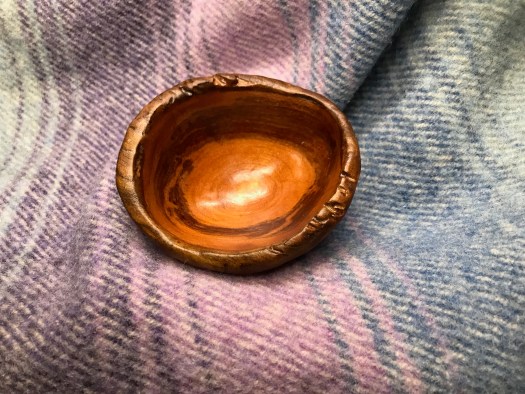
Only a few inches around, the banding on the sides and interior, and the rough lip make this one a favorite just to hold and look at. Made from a piece of cherry firewood.

This second one was also from firewood. I love the subtle grain pattern and the rough lip.

This third bowl was from a slightly larger piece of cherry firewood. I had enough wood to form a bit of a handle. I went experimental and charred the interior with a torch. Before finishing you scrape off most to the char, leaving just blackened wood. There are slight defects in the wood that in my mind make the piece even more interesting.

I’ve done a number of others, and like them, but these are my favorites.

New and Old

We can easily get lost in the weeds talking about tradition in crafts. It’s just hard to avoid observing that technology casts long shadows when you make something and call it traditional. The majority of shops that work with wood use bandsaws, table saws, and jointers. These tools have been around long enough not to ignite a vendetta among purists looking for “traditionally crafted goods.” But the technological landscape is always changing for the craftsperson.
Recently I have been nosing about on the borders. A few years ago, a series of eye surgeries compromised my ability to do certain types of woodcarving, mostly lettering. After surgery, I began to explore what I could and couldn’t conveniently do. The vision changes prompted the carving shop’s move from the old basement workshop into the greenhouse – I needed lots of light. Last year I also began to play around incorporating laser engraving and cutting as an adjunct to my carving.
Some things worked well, and others fell flat. Frankly, it’s all a work in progress. The small sign shown above is one of the projects that worked. Some of the others wound up feeding the woodstove.
Is it traditional? Well, was it traditional when craftspeople and artists began using acrylic paints or using computers to assist them in design?

Years ago, when I worked as an anthropologist, I knew a woman who crafted the most incredible Ukrainian Easter eggs. One afternoon over coffee Elizabeth introduced me to the history of technological innovation in the world of decorated Easter eggs. Over the centuries, dies and methods of preparation changed. But the community accepted the eggs because of the continuity of design and meaning in the community.
Back in the ’80’s colleagues were musing about Cambodian kite makers shifting from traditional fabrics used in Cambodia to the ripstop nylon available to them here in the United States. The maker of traditional Cambodian dance costumes received mention also. One of them had adopted the hot glue gun and factory-made jewelry findings to construct elaborate headdresses and other costume bits. They looked like the old style, but the components and techniques had evolved.

On one project I worked on years ago with boatbuilders, I asked builders what they thought was the central concept that defined the traditional boat. I had expected them to talk about materials, construction techniques, and design. I wasn’t disappointed because they all mentioned those things to one degree or another, but as a group, they said the value placed on the boat by the community that used them was central. One well-known figure I interviewed ( Lance Lee) suggested the term “cherish” as the central concept – the boats were cherished and valued by the community. It was the community of users that made something traditional.

The laser engraver that sits in the basement, and my visual handicap, got me thinking about these things. The concept of craft, especially when labeled traditional, has some minefields laid in it for the artisan. Look beyond technology to intent, the community’s acceptance of the product, and the continuation of design tradition. Sometimes we might be daunted by what we see, but the first carver who moved from a stone or bone tipped tool to one of metal started us on the moving process of technology in arts and craft.

New York Pilot Boat 5

This chest was not in stock long enough for me to do a proper set of photos. It sold at it’s first appearance at the Maine Boatbuilder’s Show to a pair of Boston Harbor pilots who were going to give it as a retirement gift to a colleague. The chest itself was of fairly common pine with teak keys for strength and decorative effect.
The top though, that’s some pine of a different pedigree. The pine tree was felled by the great hurricane of 1938. At the time it came down, it had been the tallest tree in the town of Shirley, Massachusetts. Very probably old growth, the entire top was just a segment of the plank I purchased from the retired dairy farmer, who, in true Yankee fashion, refused to let such a good tree go to waste and made it into planks.


The pilot boat itself was pilot number 5 from New York Harbor. Pilot boats had to be extremely fast and able, and this design shows a flexible sail plan and sweet lines. Somewhere I have a slew of pilot boat designs but have not had an opportunity to carve another. Beautiful boats like this are hard to resist.

for a more recent look into New York Harbor pilotage take a look at Tugsters post of a pilot boat mothership: https://wordpress.com/read/feeds/72558/posts/2868136611

Wood

Wood occupies a central part of our lives. We love our cherry spoons, Mahogany cabinets, and teak deck chairs. As consumers, there is much that you don’t know about your favorite woods.

Smell:

Ash has a sweetish odor, that is uniquely distinctive when you saw it or burn it. Fresh red birch has a scent that takes you back to the best root beers you’ve ever had. Cherry bark smells like tasty cough syrup. And oak has an earthy odor to it. If you work with fresh-cut timber, these are some of the sensations that the tree shares with you, and which the uninitiated remain unaware.

Color:

Love the look of mahogany, the beautiful color of cherry, or walnut? The tree didn’t add them for you. Trees live in a highly competitive environment where organisms are always attacking the tree, looking for a meal. To deter the attacks, trees deposit chemicals into their wood that inhibit insects, bacteria, and fungi. After we cut the timber, those chemicals give us the coloration and some of the wood’s durability.

Toxicity:

Some woods are toxic to us. A wood called Pink Ivory is lovely to look at but is dangerous because of the chemicals in the wood. In use, it needs sealing before it’s safe for us to use. 

Woodworkers need to be especially aware that the dust caused by sanding some species is irritating. Mahogany and teak fall into that category. Not everyone is sensitive, but wearing protective gear is an excellent way of avoiding dermatitis or respiratory issues.

Food Safety:

Normally most of what I’ve mentioned is not too important to the average consumer. There is one area to aware of, and that is treen. Treen ( derived from the word tree) are objects like spoons, spatulas, bowls, and the like. Being that we handle food with them, the potential toxicity should be considered. In North America, woods normally considered food safe are woods like maple, fruitwoods (cherry, plum, pear, and apple) birch, and poplar. I’ve used ash for cutting boards, but not for spoons because it has alternating summer and winter woods ( ring porosity) and might absorb odors and flavors when immersed. Oak, while not toxic, is ring-porous, and can impart it’s earthy taste to foods, so I do not use it.

You might notice that I have not included walnut on my list. I am rather certain that it is food safe, but I rarely use it because there are a good number of people with walnut allergies.

Spalted wood is wood with the patterns of decay caused by fungus visible on the wood. It’s beautiful to look at, but there is a significant debate as to whether or not it is food safe. I do not work with it, in part, because there is a respiratory risk to the woodworker from the spores of the fungus. Yes, many woodworkers claim that the spores can be killed by microwaving or heating the wood. It’s just not a risk I take.

Exotic woods. I stay away from them. For many, there are question marks regarding their food safety, and being that I used to sell commercially, I had product liability to worry about.

If you have questions about any of this, write me, and I’ll try to formulate an intelligent response.

Favorites

My father’s favorite ship was the S.S. President Tyler. He sailed aboard it whenever possible from his first voyage around 1932 till he came ashore in 1946, the year I was born. Several World and Asian cruises made him a genuine China Sailor.
Sailors, merchant or naval, can have deep relationships with their ships. Call it loyalty, affection, longing, or call it what it really can be – romance. I know, I have an ache for a certain ketch I’ll never see again. Women are known to jealous of ships and boats. My first mother in law was jealous of the Cap’ns Psyche. For the sake of peace, she hid it well. My mother was not so diplomatic about my father’s love of the sea, and “that ship.” She had been a sea widow throughout their marriage and two pregnancies. Like many sea widow’s, there came a time when the husband was expected to “swallow the anchor.” More than a few arguments ended with my father threatening to go to the hiring hall and “look for a ship.”
So growing up, the Tyler was a sensitive issue. We’d regularly drive along the Hudson River to where the reserve fleet was anchored. He was looking for the Tyler. My mother was never on any of these excursions.

I had seen my father’s pictures onboard the Tyler, But I had never seen a photo of the ship itself. My mother was famous for editing her life, so it’s more than likely that she disposed of those photos when she threw out dad’s cruise scrapbooks. For her, those were not good times.

Many years later, I was teaching marine carving at the WoodenBoat School in Maine. Teaching at WoodenBoat is not just an opportunity to learn. It’s an opportunity to grow as a person through the freindhips formed with the individuals you meet there. One year one of my students was a former Master Mariner who worked for the American Bureau of Shipping. We talked about ships one night, and I told him all that I knew of the Tyler and my father’s affection for the ship. I mentioned that I’d love to carve a portrait of the Tyler but could not find enough data to start the project. I thought no more about the conversation, and at the end of the course, said goodbye to my students and returned to Massachusetts.

About three weeks later, a large envelope arrived from the ABS (American Bureau of Shipping). In it was were copies of plans and articles relating to the class of vessel to which the Tyler had belonged; enough to start the portrait. My student had searched the ABS library for the documentation that I needed.

The Tyler was my first large portrait. I can now look at it and see a dozen things that I would and could do differently with twenty years of experience carving portraits. But when you finish a project it’s best to move on, or you’ll never finish.

It sails on my wall with a cherry ocean and sky heading east from Japan or China towards Los Angelos. I think my father is pleased that his ship is restored to an essential place in our lives, through the unexpected kindness of a fellow seaman.

Eagle Eyes

While teaching, I always like to decorate the workshop with carving examples for students to use as a reference. Week-long excursions to teach away from home mean emptying the house of many of my carvings. But samples in three dimensions often are better than pictures or demonstration, and the extra work was worth it.
During one summer course, A student was working on an eagle and suddenly stopped, got up, and went over to an eagle billet head. He picked it up and turned the head away from him. Noticing me watching, he shrugged his shoulders and said: “it was watching me.”
Smiling, I pointed out that he was perfecting the eagle’s body plan and feathers without working on the head, most notably the eye. He asked me why it mattered, and I told him that it was essential to fair the contours of the head and neck into the body, so the eagle looked all of one piece when finished. The head is temporarily attached to the body with a screw while you carve the neck fair to the body.
” But why was it watching me?”
Well, I explained, years ago, while I was first carving eagles, a talented carver from Boothbay Harbor advised me to always start the head before detailing and finish the eye first. There was a practical reason for this. The eye was a delicate piece of work, and if not done right could ruin the whole birdie. He then added that he had been taught to do the eye first so the eagle could oversee the carving’s remainder. ” As I was taught, so am I teaching you.” I then turned the eagle about so it’s beady eyes were on the student. ” Being that you haven’t done the eye first, this birdie’s cousin in watching you.” I can be a first-class pain sometimes.

I carved the eyes on that particular eagle with a “tunnel” eye effect. With that manner of carving, you could get the impression that the eye watches you and moves with you. To someone easily spooked, like my student, it could be an unpleasant sensation.
There are several ways to carve eagle eyes for traditional marine eagles. Please note that if you carve more realistic styles, these will not appeal to you. I’m a nineteenth-century carver stuck in the twenty-first century. Be all modern if you like. Another ships carver reminded me that most people do not get close eough to smell the eagle; all these things in full size are meant to be viewed from a distance. Here are some examples of eyes:

Twentyone

“The world of reality has its limits; the world of imagination is boundless.” Jean-Jacques Rousseau

The problem with imagination is that it’s boundless. On the wall is a poster telling you that you can do it if you can imagine it. Don’t take it too literally.

Aspirations aside, there are some things only possible with loads of tricks, like telling fortunes. My friend Bill had picked up some tricks of the psychic trade from working with a con artist we knew as John. Bill had a natural talent for reading people, and with the card and vocal tricks he had picked up from John, he was soon a favorite among the weekend influx of suburban kids that regularly hit the Folkie Palace. 

From fortune-telling with the kids to doing it at the Harvard Gardens for beer was a natural progression. “Imagine.” he told me- “I’m doing well while doing good.” At first, he restricted himself to doing readings for friends, but as he grew more confident, he branched out. Lovelorn young ladies came to be a specialty. One attractive woman decided that she wanted Bill’s services exclusively. He demurred politely. She grew insistent. He explained that he was married. She slapped him and walked out.

Not too much later in walked police Sargent Cappucci with the young woman behind him. We all stood up to give Bill the needed cover to run out past the men’s room and the back door into the alleyway. Knowing that Bill and I were best friends, I got collared. “Tell your little buddy that I ‘m looking for him. Playing with the affections of my niece is something I won’t tolerate.” He shoved me into the booth, and away they walked. Him fuming her crying softly. “His niece.” Said the Teahead of the August Moon. ” Sweet. Bill can always find some way to get us into trouble.”

For the next couple of weeks, we were not in good favor with the residents of Grove Street. It seemed that the entire street attracted more casual police attention than usual. Squad cars were cruising by. Officers were poking around. It curtailed summer parties and other activities. It became common knowledge that we were the cause of this attention. As a group, and as individuals, we got uninvited from everything happening in the neighborhood. People avoided sitting near us in the Harvard Gardens. 

Bill suffered from none of this. He had departed for Baltimore right after the trouble at the Gardens.

As is often the case, we don’t learn from our mistakes unless we suffer from their consequences. In this incident, only Bill’s friends have. So it came as no surprise that no one at the Folkie Palace was willing to contribute to paying the fine to get Bill out of jail in Baltimore.

He had been cutting into the action of the”legitimate” psychics in Downtown Baltimore, and they had tipped off the police. I hitched down, solicited as many of our friends as possible, and got him out.

He was a repentant, Bill. a Bill who promised never to tell a fortune again. Besides, while in the joint, he’d met this great guy who’d taught him how to count cards in Blackjack.

” Wes, have you ever been to Vegas?”

Steak Tips

Daily writing prompt
What’s your favorite thing to cook?

I don’t do them too much anymore. We eat less meat, but one of my favorite dishes was a roasted steak tips recipe that was finished over a flaming bed of coals. It came about from grad school dietary boredom.

I was very poor in grad school and spent a lot of time searching for good, but inexpensive, materials that I could cook with. I was also living with a cat ( Clancy, the Grey Menace). He fancied himself an epicure, gourmand, and not the sort of kitty who was satisfied with Friskies every day. Let him get too bored and spend time being apprehensive about losing O Negative blood in a fight.

Luckily for me, there was a local farmer’s market not too far away where many of the local Pennsylvania Dutch farmers sold their produce one day a week. It was my lifeline to good food at a reasonable price. Among my indulgences every so often were some thin cut steak tips. These I’d take home, carefully sautée in a sauce I’d mix from Worstershire sauce, spices and wine, and lightly bake. Then I’d finish them on my little Hibachi that I had in the back yard. The Grey Menace stood guard to ensure that nothing was stolen.

At the perfect moment, the tips were removed from the hibachi and served with a salad for me and a bit of cat food for him. For a poverty-stricken grad student, it was a splendiferous treat. Clancy of course demanded seconds.

The Numbers Game: #110

And Judy’s number today is- 232

  • Last winter’s dispay of carnivvierous plants
  • orchids
  • Marcus in a celebratory Christmas mood
  • A carved portrait I did of the steam yacht Zaida
  • The trustworty Magic Eightball
  • Ed Menard is a skilled Vermont woodcarver. This miniature cedar fan is one of his works. What Talent!
  • The decoration on the hilt of a Japanese sword
  • A Sir Walter Raleigh figurehead in the collection of the Peabody Essex Museum, in Salem, Massachusetts

Look Ma, No Punch Cards!

Daily writing prompt
Write about your first computer.

I credit undergraduate computer science classes at Boston University for my early computer literacy. As an anthropology major, I wasn’t expected to do any heavy lifting for my science requirements – no physics or chemistry. But we were expected to meet a distribution in all areas. Remember that? A Well-Rounded Education?

So in my junior year, I took several geography courses. One of the geography professors was interested in cultural geography and had us working on statistical problems in cultural geography. This gave me an initial introduction to statistics and cultural geography. In the process, I had to learn to set up and accurately run statistical programs on the mainframe computer. This involved boxes of punched cards and hours spent at the computer center. This was the spark that introduced me to the use of computers.

The effect on my anthropology was enormous. My Junior year honors project involved some statistical analysis of datasets from my research in Coastal Maine. It was educational not only for me, but for some professors. My use of computers continued in grad school with the use of the old DARPA Net, a predecessor of the Internet. Use of computer technology would not engulf the analysis of anthropological data across the four quadrants ( cultural, physical, linguistic, and archeological) for years. Still, I was in at the start, running analyses for the professors. I spent almost as much time at the computer center as I did in classes.

Apple

After I left grad school, I had no access to academic computer systems. But I eventually scraped together enough money to buy an Apple IIc computer. I literally beat this system into the ground with use, and I drove it to the limits of its capabilities. With an old-fashioned modem, I continued analyzing data, played early computer games, and had a ball. The old Apple IIc led to a succession of Macs, and I will soon need to purchase another one as my current one is getting old. But I still remember the boxes of punch cards and the frantic insanity that happened when one accidentally spilled on the floor. Hours of placing the cards back in order resulted. It was not something you ever wanted to repeat.

Last on the card – January 2026

Shot this the other day at the building I work at. It’s been an “interesting” winter here.

Tropical and Exotic!

Tomorrow is seed and plant catalog day, and that raises a little issue. My annual experiments. You see I like to scratch an itch every year to try at least one thing that is impossible or improbable to grow in my New England climate. For years I’ve kept an assortment of citrus plants alive and at least semi-thriving on window sills and grow lights. During the summer they grow ungainly outdoors. Then there were the years that I grew banana trees inside from seed. While I was a bachelor they added a distantly tropical look to the old apartment. Hmmm….the cats would probably enjoy hide and seek among the foliage.

So tomorrow as I leaf through ( I couldn’t avoid that one, sorry) the pages of lettuce and spinach seeds I’ll also be looking for my exotic picks as well.

Bad Dreams of Winter

Daily writing prompt
What’s the thing you’re most scared to do? What would it take to get you to do it?

I’ve known people who are happiest in the winter. I dated one for one awful August. It was, “Winter is so wonderful! I can’t wait till December !” Being it was a hot, humid August in Baltimore, I could tolerate this for a while, since my crush was an incredible woman, a great conversationalist, and otherwise a great partner. Then I realized that this lady would be going on about this forever. Perhaps she’d agitate for a move to the Arctic Circle, or something equally distasteful. I, being a winter hater, made for the exit signs.

A close-up of a thermometer displaying temperatures in Fahrenheit and Celsius, with the reading showing a temperature well below freezing, set against a snowy outdoor background.

So there you have it. What am I afraid of? Waking up to an endless winter. Now don’t get me wrong. I have several pairs of show Shoes in my shed, and I’ve been known to enjoy snowshoeing through the woods. But not for months on end.

Solutions

I have a mild touch of seasonal affect disorder. To get through winter takes planning to maintain my health, keep entertained, and get involved in constructive activities. So far, this winter has been a positive one. The best bit of my action plan was to take some Physical Therapy. The exercises I’ve been assigned are working on some lower back and foot issues. I’ve found that my posture and balance are improving. That makes me feel better, have a more positive outlook, and be more eager for physical engagement.

Overall, these things offer support and structure, not a cure. The cure comes when the day length increases, the snow disappears, and the flowers in the woodland garden start popping up.

In the meantime, you’ll find me in the evening dozing in front of the woodstove with the dog and cats who pretty much feel as I do.

Shopping List

Just before checking today’s prompt, I was writing out the shopping list. Cinnamon, hmmmm. It’s frosty as heck out there, Minus 15 when I got up. Cinnamon? Ahhh, add cider. Yup, a good cup of hot spiced cider in front of the wood stove tonight. Just fresh apple cider, some cloves, and of course, cinnamon.

Enjoy.

Whack!!!

Daily writing prompt
What do you complain about the most?

I occasionally veer into politics in this blog, but I’m not interested in making the blog a political vehicle. So while I daily complain to myself, my wife, family, and friends about politics It’s peripheral to this blog. However, like many of these days, what’s going on is a huge weight on me.

So what do I do about it? OK, laugh if you will, but I take my yah-yahs out on the wood pile. I’ve reached that point in the winter when I’m into some red oak that needs some further reduction in size for the woodstove. Up on the block goes the large hunk of oak. Thawak!!! goes the maul. After a while, a pile builds up, and I have to clear it. I can sometimes be heard muttering vile imprecations of a political nature. My grin might remind you of Jack Nicholson in The Shining, “Here’s Johnny!”

Yes, a certain manic air surrounds the scene of the violence. I am innocently chopping firewood that’s all. No heavy psychological junk involved…”Die sucker die!….errrrrr I mean that’s one twisted piece of wood. Needs another whack!

Tying Knots in the Devil’s Tail

I address the WordPress prompt most every day. Being that they often sound like questions cribbed for personality tests, I usually twist, spindle, and mutilate the prompts in whatever creative way that I can.

A challenge can be when it’s the third time you’ve answered the prompt. Then you have to get crafty, devious, and perverse-minded. But, hey, I was Pius Itinerant ( road bum), and an anthropologist; it sort of comes as second nature.

But seriously, I wonder what goes on at Prompt Central, you know, those old cubbyhole offices down the dark corridor, past the old bathrooms nobody uses, where the vending machines all have stale items in them. Some prompt technician, third class, is trying to analyze my twisted and warped sense of humor. It’s not helping his stress levels, blood pressure, or digestion.

In the meantime, I’m just looking out for my next diversion. We used to call it “Tying knots in the Devil’s Tail”.

Sports? Meh.

eagle weathervane
Daily writing prompt
What are your favorite sports to watch and play?

At this point in life, I neither play nor watch sports. The other night, I was reflecting on this and realized that in the past, most of my involvement in sports was a sort of community item. I played baseball when I was a kid because all my friends did. Then I watched hockey for years because I had friends who did, and I enjoyed the time spent with them. I enjoyed all this, but as a group activity, not something to do solo.

I was enthusiastic about football for a while because my brother-in-law was an avid fan, and we were very close friends. But when they moved away, watching a group of padded men move a tiny ball from one end of a field of grass to the other seemed less critical.

Hockey was the sport that made the largest impression on me. It was the more aggressive sport of the nineteen sixties and seventies. There was lots of aggression, fast moves, snarling, and shouting by the folks attending. Cat hockey is the name I tagged onto the games my cats play with busy balls and other toys. Their moves are reminiscent of the human game. And when Sabrina calls a foul on Marcus, off come the gloves for a fight, and Max ( our cattle dog wants to break it up.

In anycase in a shameless attempt to make you read more of my posts here are some links to my cat hockey stories:

Louis N. Carreras, Woodcarver

Authentic Nautical Accessories, and Custom Furnishings

Skip to content ↓