
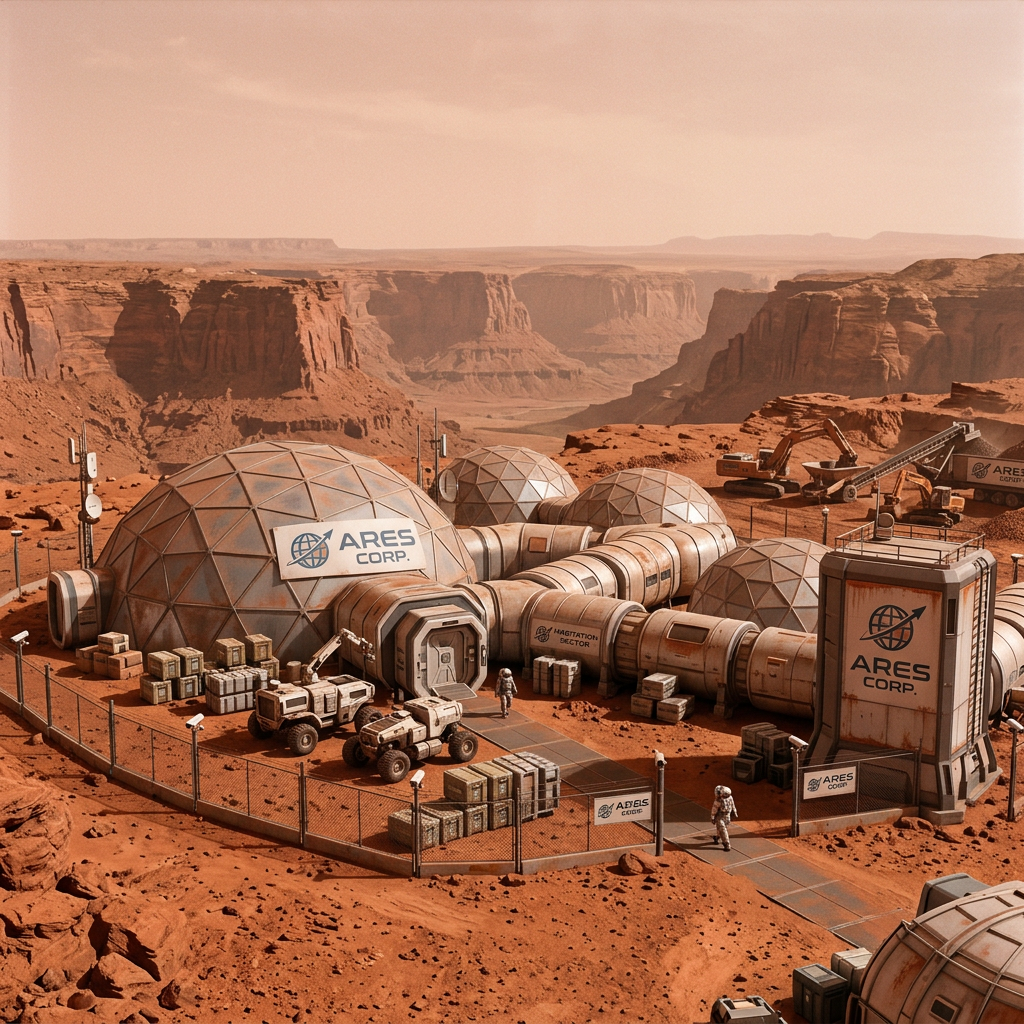
It’s a long way to Mars, and it’s not going to be either a cheap trip or a cheap job to get a settlement established. So my questions are not so much if we can or should do it, but what sort of terms and conditions will exist if we do it. Who foots the bill, and how is it run?
Who foots the Bill and Why?
It’s a long journey out, and while pure science is nice, it’s not like running a crew and supplies down to an Antarctic research station, which is really about the closest analogy we have. Closest, yes, but hardly in the ballpark considering the fact that we have to bring, or extract, much more of the basics than we did in Antarctica. So, unless we figure out a cheap way to create shelter and breathable atmosphere, there will have to be either a compelling reason to spend big bucks, or something extractable, or manufacturable to propel the effort. Return on investment could be a big factor.
Perhaps as the scheme develops, we might get away with getting robotic agents to do much of the work remotely. This would save money and effort on getting a habitable zone set up for the initial stages of settlement. Perhaps a team sits in orbit directing the early efforts. But if the real goal is to get humanity spread around the solar system sometime, you’ll need to get the proverbial space boots on the ground – a fresh start, on a new world.
But wait. This is an expensive venture at the end of a long supply chain. If you decide you don’t like working at Mars Minerals Incorporated. You can’t just hop on a bus and start a new job search in the morning from home.
Someone, a corporation, or a government has spent a lot of money getting you to their venture in the sky. They have a lot riding on your being a productive member of their little company town. And, unless multiple entities start up in proximity, it will be exactly what you have – a company town.
Company towns were beginning to fade in the States when I was on the road. Towns were growing, and the economy was diversifying. But I remember staying in one or two for a while, building up a stake, pursuing a pretty girl, or just taking a break from my wandering. They were one stop. The primary employer was typically something like a mill or a factory. The other businesses in town were tiny, and the economic health of the Town depended on the economic health of the mill. People I met there could typically be second or even third-generation employees of the mill. Popular media -books and movies- generally portray these company towns as being a sort of closed-loop environment. Stay in your lane, and don’t rock the boat. There was nothing covert in the company’s interest in controlling the workforce. Rows and rows of former company housing still survive in my state, where workers lived and had families who grew up to work in the factory.
In an early settlement on Mars, it’s more than likely that housing would be provided by the employer. What sort of contract, conduct, or return would the employer ask in return? Remember you wouldn’t be able to hop a bus or drive to another nearby employer.
In the annals of early industrial setups in the United States in the early nineteenth century, the answer would be at least paternalistic, and considering the harsh environment maybe dictatorial.
My intuition suggests that before signing a contract for transportation to Mars for employment with Mars Minerals Inc, we should take a careful look at all the clauses about workers’ rights. If we quit six months in, and the trip back is six months at the company’s discretion for transport ( read the modern version of steerage, or in the hold), it may not be the bold step into the future of mankind that the advertisement suggested.
No, I’d heavily annotate and bookmark the contract, and have it read by my own lawyer before stepping aboard a transport to what’s being billed as the future site of Mars Port.
Am I skeptical? You Bet. A casual read of history suggests that, unless there are guarantees, abuse by the mill owners will be the result. And remember it’s a long way back to your hometown, and you won’t be able to hitchhike to the next town.
Discover more from Louis N. Carreras, Woodcarver
Subscribe to get the latest posts sent to your email.
Considering Elon Musk is the current poster child for “going to Mars” and is all in the news as it pushed him into being a trillionaire… “What could possibly go wrong?” [asked sardonically]
I don’t think Elon would be a fan of democratic colonial government. If you went to Elonland I’d say “let the buyer beware.”
Every once in a while I get a contest book with a story about people who’ve gone to Mars to work. It’s a very cool imagination point because the stories are often very good. As for me, I think of Total Recall, and Ahnold saying to Sharon Stone, “Honey, lets go to Mars.”
When I was about 13 I read the entire series of Edgar Rice Burroughs books on mars with canals, Deja Thoris and John Carter. Somehow his fantastic imaginings of an impossible Mars left a real impression. After that I becoame a real SciFi nut, but was truly disappointed to learn that John Carter’s Mars was a total impossibility. The more realistic stories may have been better SciFi, but they lacked that zing the sheer fantasy had.
Fantasy doesn’t ask us to close our imagination. One of my all-time sci-fi books is so fantastic as to be absurd “Galactic Pot Healer” by Philip K. Dick
Thanks Marha, I’ll have to read it again!
I should too.
This post made me think of the book, Artemis by Andy Weir. It’s set on the moon, but has great detail about how the colony is physically arranged and how it all works to keep people alive with air and other resources. Not even close to as entertaining as The Martian or Project Hail Mary, but for the description of the infrastructure, it’s worth a read.
Your mention of supply antarctica gave me a thought though: that would be a great way to test Martian buildings or communities. Build them first in Antarctica, or better: under the sea, and see how that goes.
I think you are right. You’d want some extreme environmental testing that you wouldn’t get, say, in near orbit or on the moon.
But it’s the societal and political complications that might ultimately create the largest problems. Especially after the initial period of building and testing, as things settled into a rhythm of life, and people lived there for years, and perhaps started families.
Interpersonal relationships could be a huge factor. Can you imagine being stuck in the same circle as an ex (ir two) or a sponging relative?
No, we have enough problems getting along on Earth. Location doesnt change human nature. It could end up like a ship where the crew mutinies. Put the boss outside without air.
Exactly!