
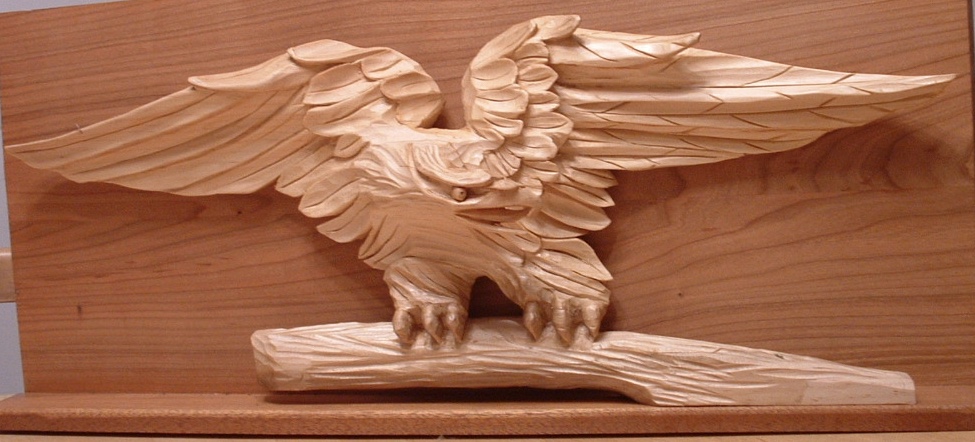
I carved professionally from 1969 to 1975, stopped for grad school and a career in anthropology, and resumed my craft as a carver in 1992. It’s a long time to remember every little detail of how you carved a particular style of clamshell end on a quarterboard. But there is an answer for that failure of memory.
My shops, porch, and rooms have become littered with my carving – small and large. It’s not because I am an egotist ( well, just a bit). I needed the models and samples for when I did boat shows and for when I taught. I also need the samples as reminders.
You can forget details of how you did something twenty years ago. Carve a dolphin, a lizard, or any other animal, and after you finish, the details will be bright. But don’t carve another for twenty years, and you scratch your head and ask, “How did I do that?”
The eagle head blank sitting on my workbench is a good case. It’s been about twelve years since I did a large eagle, and I am looking at the eyes on my models and samples for clues of how I’ve cut the eyes before.
On occasion, this has led me to new and different ways of doing things. When I finished, I realized my hands went down an alternate path to carving the neck or detailing the feathers.
When I was starting out, I had a mentor in Baltimore. Warburton specialized in carving saints, elaborate chasing and engraving, and much more. His studio/shop was down by the harbor in an industrial area. The workshop was on the main floor, but a mezzanine above was crowded with samples, prototypes, and models. He claimed that art was not a process of unanimous acclamation. You played with your media, and you played with technique. Otherwise, it wasn’t a creative process; you may as well have been a factory turning out duplicates.
Since then, I’ve worked in boat shops littered with molds and patterns, seen the casts Rodin used to create his work, and noticed the remains of patterns from old shipscarvers’ shops.
So, I’ll examine the eagle eyes and carve it before I do anything else. I don’t know where I picked up the habit, but I carve the eye first so the “birdie” can watch the rest of the carving. By the time I finish, my memory of how to carve eagle eyes will be all bright and up to date. Maybe this time, I’ll actually take out the journal and scribe in some notes for the next time. Naw.


Discover more from Louis N. Carreras, Woodcarver
Subscribe to get the latest posts sent to your email.
An eagle would agree that without eyes, he won’t live very long. I think that’s a thoughtful way to begin.
I, for one, think everything you’ve shown of your carvings thus far has been lovely, my friend… hugs
Thank you!