
When my first father-in-law, the Cap’n, discovered I could carve, he began thinking about how this could be used in one of his enterprises. He was famous, or infamous, around the cove for preying on summer people needing services for their boats. Once I came along, services were expanded to include much work the Cap’n didn’t care to do: scraping and painting, “wooding” old varnish off of woodwork, and other stuff known around boat yards by an extremely derogatory descriptor.
My budding ability to carve soon found expression in carving boat names on quarterboards. And my first attempts at eagles were quickly gracing the interiors of cabins, and over the entrances to summer people’s cottages. These days, I wouldn’t want to acknowledge these early attempts. One survives in my collection, and I usually hide it away. When showing off my work, I skip over them. To term some of these efforts “folk art” would be kind. But for a certain price, and sold to the right clientele, the Cap’n found a market for them.
The first workbench was in the garage at the house overlooking the cove. My cat Clancy, AKA the Grey Menace, would sleep by the woodstove until bored. Then he’d go and harass the neighbor’s dog. It wasn’t a bad place to work. Until one day the Cap’n decided to evict me for a large project he had. I’d have to move, temporarily, elsewhere.
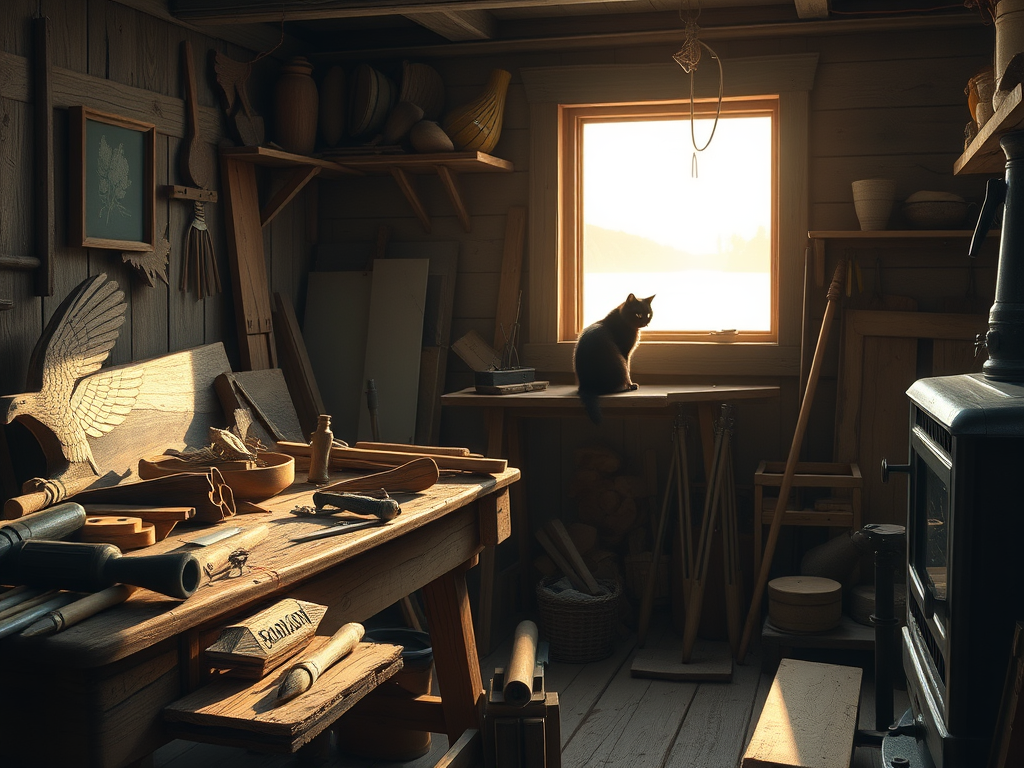
Elsewhere turned out to be down in the cove to the workshop of a semiretired boatbuilder, Gus. Gus probably had not cleaned the sawdust off his benches since the last boat he’d built ten years previously. You could describe it as picturesque with all the patterns hanging around the shop. I just called it dirty.
I spent the first day trying to clean a bench to work on, moving in tools and projects, and generally getting set up. After that the workdays took on a pattern. Show up in the morning, drink awful coffee, work on a carving, but mostly talk to Gus. Gus, it seemed, had not spoken to anyone for ages. He just left his house for the shop every morning, and spent the day puttering around. At five, he returned to his wife and dinner, and watched TV. My presence offered a distraction – someone to talk at, and too.
Discussions were free-ranging and surprisingly useful. I’m an anthropologist, and I was interested in the local community. Gus would mouth off for hours about the neighbors, local history, who built what and why. Outside of service in the Navy in the Second World War, he had rarely been further away from home than Portland or Bar Harbor. A trip to Halifax was memorable because of a young woman he’d met there.
During the War, he’d briefly been stationed in Boston. The infamous Scollay Square was his favorite place for liberty while in Town. He was heartbroken to find out that the city had torn it all down, and the Burlesque house, The Old Howard, was no longer there. This began an ongoing discussion of what had changed in the “outside world” since he’d come home. Yes, Gus watched the news on TV, but I was from New York, lived in Boston, and wandered about.
I had much to tell, but so did Gus. His wartime deployments had taken him to Hawaii, the Philippines, and a brief post-war visit to Occupied Japan. We found common ground talking about dive bars we had frequented.
Eventually, the Cap’n finished his project, and I returned to the garage overlooking the cove. But at least once a week, I’d wander down for coffee and discussion at Gus’.
Discover more from Louis N. Carreras, Woodcarver
Subscribe to get the latest posts sent to your email.
is he/she your assistant dear Lou? Beautiful photograph. Thank you, Love, nia