


Sshhhhhhh! Let’s not tell anyone. And especially not the lawyers…they’d never understand!
Well, OK, just between you and me then. My secret ability was adaptability. I was often thrown into situations by life and sort of asked to “make something of it”. You know, being given a box of random parts and creating something from them. Not so much mechanically, but in terms of the sort of applied anthropological jobs I was given.
In my first professional job after grad school, I was hired and promptly told that there was only six months of funding, and I was on my own for resources. I had been hired to create cultural programming for a diverse urban population. The expectations seemed to have been that the Italians would never come to a Polish program, or the Portuguese with either of those, and the Irish would ignore the others as well.
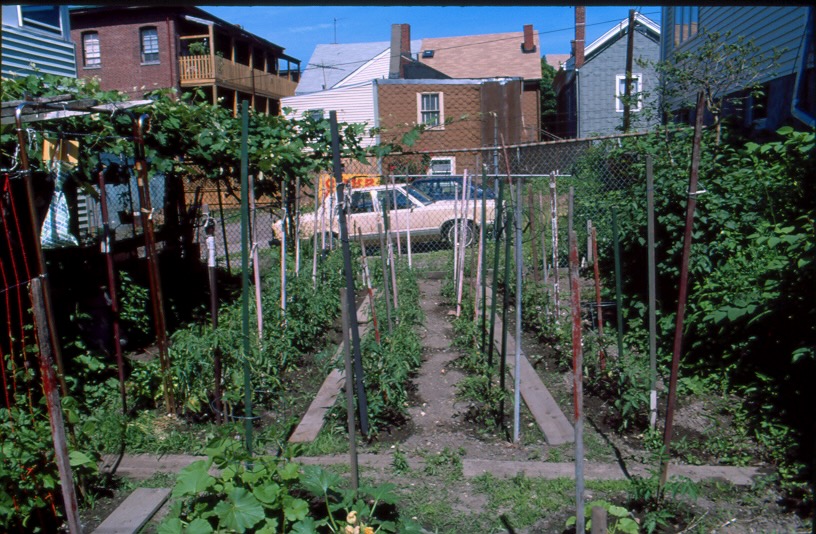
I started with simple programs and did sneaky, basic ethnographic field research. I was looking for something that either bound them together as a community or that they shared. I found it in gardening. It was a small community within a larger one – only a square mile in area, but it was a fecund area for a cultural anthropologist to be thrown into. “Oh No! Please don’t throw me in the briar patch!” I found what I needed in the neighborhood gardens. Each ethnic group had different gardening traditions, and they frequently coexisted right next door to each other. Mrs. Gelowtsky discussed her garden with Mr. Fabrizio across the fence. And garden products were shared.
The Hidden Countryside
The Hidden Countryside was what I called the program. It did a lot of comparison and contrasting of the different ethnic gardening traditions in the neighborhood. I was a bit sneaky in my tactics. I was in one person’s garden one day, and then the next-door neighbor was asking if I might be interested in visiting theirs. By September, I had a large slide presentation ready. The gardeners decided to hold a large Harvest Festival at my Heritage Center, and the centerpiece was the slide presentation called the Hidden Countryside that featured all the traditions. Additionally, the gardeners, male and female, did not have a gender predominance. Everyone was represented.
It was a huge success and a hit with the Ward’s City Council member, too. He was influential in making sure that our funding was extended.
At The Movies and More
The next summer, I received training in video and used the data gathered for the Hidden Countryside to create a video. In those pre-digital, pre-Internet days, we “bicycled” the tape around to neighboring Public Access television stations, had another Harvest Festival, and showed the video presentation.
Eventually, in 1987, the Smithsonian Institution became interested in our work (mine and the community members!) I was hired to do extensive fieldwork for the Smithsonian, and in 1988, many gardeners were featured as part of the Smithsonian’s Festival of American Folklife on the Mall in Washington.
Onward
So that’s pretty much what I did as an applied anthropologist. I’ve applied the skills and techniques pretty broadly through the career. Although I am not currently working in that field, the approach is applied to whatever I do.
Discover more from Louis N. Carreras, Woodcarver
Subscribe to get the latest posts sent to your email.
I love this! “Hidden Countryside” — that’s just beautiful.
That is impressive, Lou!
Absolutely marvelous work, Lou. I love this so much. A perfect use of anthropology and your sneakiness was exactly what was needed, I gather. Very impressive to have had the opportunity to contribute to Smithsonian planning, too.
I did bigger projects after, made more money, had staff, and ran lots of programs. But it was an absolutely career-defining project. You do not frequently find things that fit together so smoothly.
Ohh… then there were the ethnobotanical and ethnomedicine aspects that peeked out over the years. That stuff was never adequately studied – unfortunately.
This is exactly what the community gardens here are like. People from all walks of life and no gardening spaces getting together to create a Community Garden. Produce and stories are swapped, lives enriched and healthier eating ensues.
It sounds exactly like what I found. Funny thing was, it was the “poorest” part of Town, but culturally the richest.
Same in most parts of Australia
Your secrets are revealed. Fabulous initiative.
That is very interesting. I grew up in a mostly Italian community, and they all grew the same things in their gardens.
In Eastie, the Italian was next to the Pole and the Portuguese. They grew different things or different varieties. Sometimes they shared, and sometimes they wondered about the weird stuff the neighbor grew, or the way they grew it.