
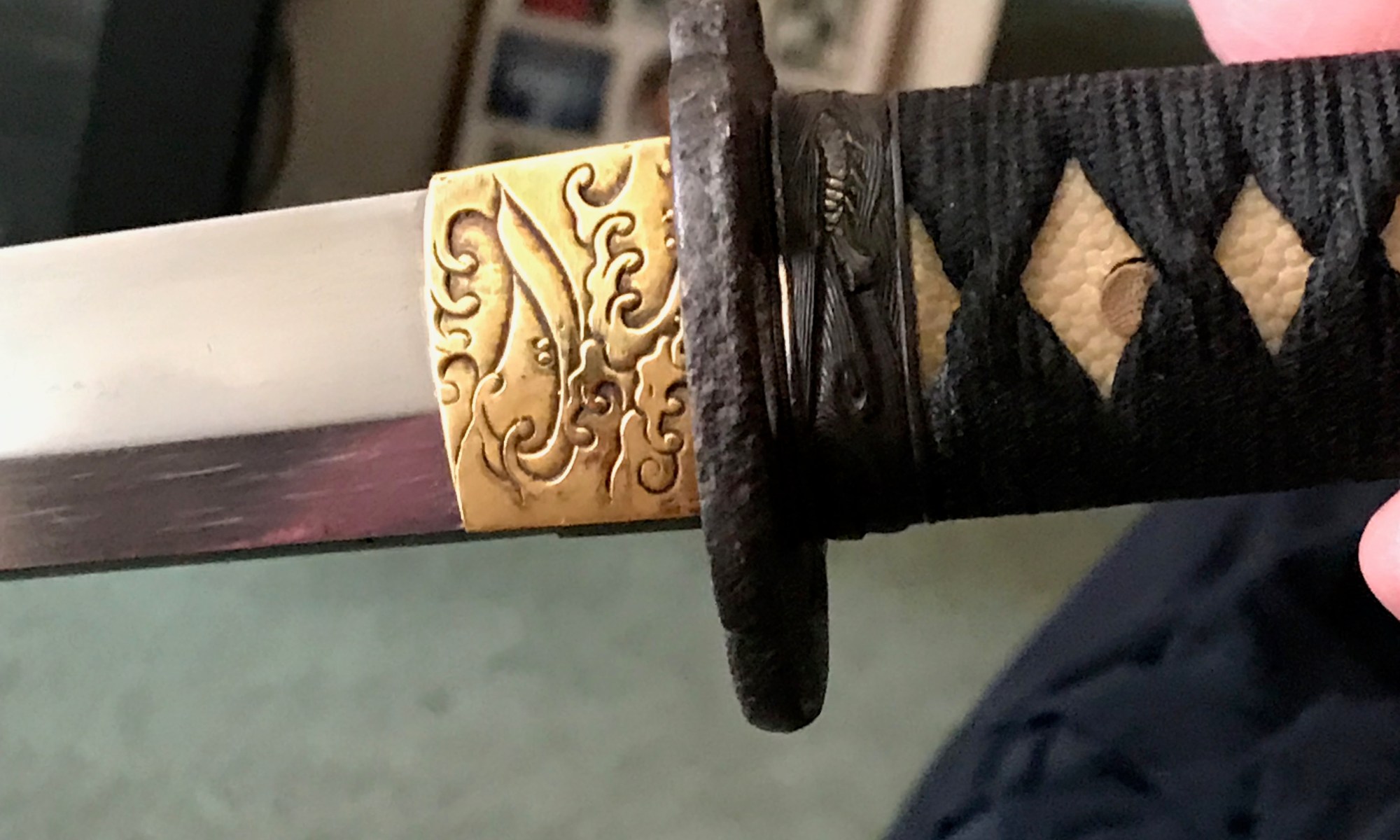


Up until Covid ruined it for me with massive post-infection arthritis flares, I was a serious martial artist. By age sixty, I felt I’d aged out of Judo, but I still wanted to practice a martial art, so I took up the sword. Literally.
When COVID-19 smashed me, I was a San Dan (third-degree black belt), and was qualified to test for my Yon Dan belt (fourth-degree and first of the sensei ranks). So, what type of sports team would I like to form? A swordsmanship team.
I was fortunate to have sensei who practice Iaido ( the art of sword drawing) and kenjutsu, basically what you do after the sword is drawn and you are fighting for your life. Iaido appears to be very cerebral. Your enemy is your mirror image. A demonstration, called an embu, can look like a deadly ballet or a dance. But the critical rendering of judges reveals the flaws in the technique that would cost your life in actual combat. Iaidoka tend to be agile and precise. Unlike some fool who buys a cheap sword off the internet, the Iadoka would never seek to harm the innocent. A true Samurai is a servant and a protector.
The team is all dressed formally in hakama and keikogi, the traditional costume. A few discreet sponsorship badges indicate which Daimyo supports the team. Blood is not drawn, and the crowd is silent. The audience watches for the almost imperceptible shifts in blade angle on the draw, the smoothness of the cut, and how accurate the cut is in cutting the target area. You win.
Sorry folks, hockey it ain’t. But deadly it is. The mascot? A cat… the original cut-and-slash artists.
Discover more from Louis N. Carreras, Woodcarver
Subscribe to get the latest posts sent to your email.
A cat??!! My crew jumped up with hoots and hollers! 😹 What else would it be?!
Yes, the most critical judges have been cats. H.I.M. Xenia used to come into the living room in the mornings to watch me practice. She always felt my slash was not as good as my cut, and I should watch her technique carefully.
haha! I can so picture the disdain on her face as she watched you practice…
Pity mixed with disdain.
I want front row seats please… and if it’s ok with you, Brutus and Dinky would like to be there as well… no worries… they don’t eat cats!
Shoes come off at the door, always step around rather than over swords on the floor, bow politely to everyone, but deeply to your seniors, and remember senior ranks practice with “live” edged swords, not dull, and care must be taken. Domo arigato gesimas
it would be an honor to watch you, my friend, all joking aside…. hugs
I have had the opportunity to watch masters a couple of times. It’s scary and beautiful. As for the deliterious (sp) of Covid? Grrrrrrrrrrrr.
California has extremely active Iaido anf Kenjutsu communities. You may have watched some of our best.
Very cool! The first time I saw it was at the Festival of Asian Arts and Culture that I actually coordinated in Denver in 1984. Then I saw it again in Balboa Park in San Diego– it was a huge event. Wonderful to watch.
The Nanadans and the Hachidans (seventh and eighth degree black belts) make it all look so easy.
Graceful and dangerous.
I want to learn this. Thank you for sharing.
If you want to learn it look for a traditional dojo that teaches Japanese martial arts like Kendo, Iaido or Kenjutsu. I started at a fairly advanced age, so that’s not a limiting factor.
We initial progress come hard. Take a look at some Youtube videos, and bear in mind that it will take years before you look that good demonstrating kata.
Wow, thanks for sharing your experience Lou! I learned many of the principles of swordsmanship and iaido from my Taekwondo teacher but the actual sport of using iaido in kendo sounds like a blast.
I run a martial arts blog and will be sure to write more about kendo in the future. I’ve already written an article overview about learning and using the katana: https://pathofmartialarts.com/katana-sword/
Hi Weston, I’d point out that mastering the sword is very much like mastering the Japanese game of Go – you can learn the basics in an hour, and then spend a lifetime learning deeper aspects.
On a second point – use as a self defense weapon in the home – most of the basic Eshin-ryu katas are for the long sword. But in interior fighting the shorter wakeshasi (literally ‘companion’) would have been a better choice. The katana and the wakashasi formed ther daito or pair of swords the samurai traditionally carried. Most schools have reduced this to just katas using the katana.
In addition there was a short sword called a tanto which was a deadly personal utility blade ( about a foot long).
I do not “play” Kendo. But one of my sensei mentioned that most upper Kendo ranks now require ranking in Iaia as well because post war Kendo was losing it rooting to the sword. Their are some very intersting video clips of pre-war Kendo available – very interesting, and I think you might enjoy seeing them.
Have fun.
Hey Lou!
Comparing the sword to go is a great analogy. I’ve been practicing it for many years and there’s still so much to learn.
Thank you for mentioning the wakeshasi. Most martial arts weapons are too long to be effectively used inside a building. I rated the sai and tonfa fairly high for in-home effectiveness because of their size, defensive moves, and non-lethal capabilities.
I’ll take a look at those pre-work kendo videos you mentioned 👌