
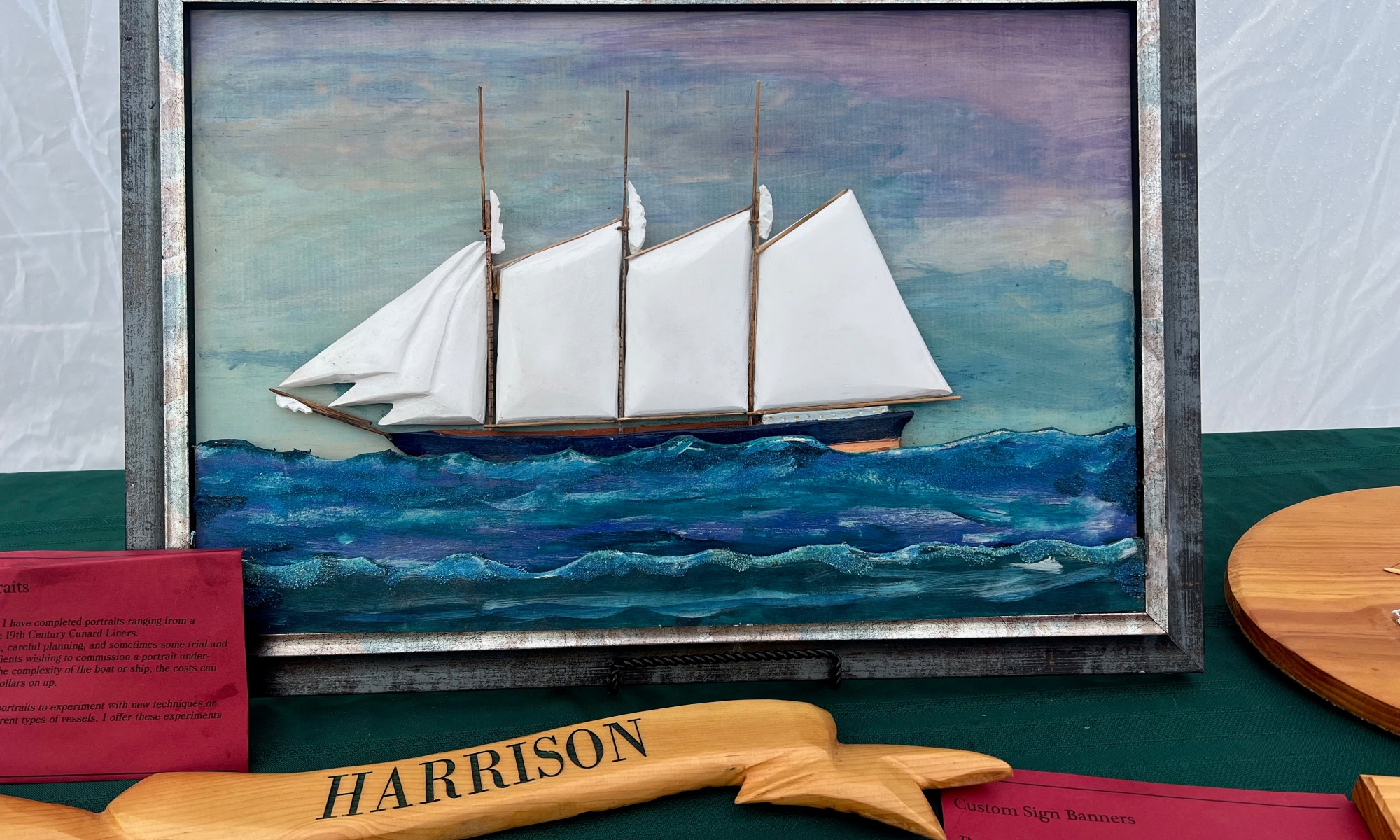
Going into Will’s workshop was always on par with entering a sorcerer’s hut. He might be working on anything. Sometimes it was toys for the grandkids, trap stock to make lobster pots for Lowell down at the Cove, or a boat. The rafters hung with templates for boats made anytime in the past century or more. Will’s father before him had built schooners in the Cove below. On the walls were old black-and-white photos of shipyard workers, ships, and Island scenes from the last century. The one I always look at has a crew of workers wearing vests and bowler hats in front of a schooner about to be launched.
Today, Will was working on a half-hull model of an old-time schooner. “Coffee’s where it always is, Wes. Help yourself.” So I wandered over to it, grabbed an old tin cup, and poured some of the worst coffee available in the state after carefully blowing off the sawdust. ” Thanks, Will; by the way, those quarterboards are about finished – just one final coat of varnish. What Schooner is that?” He winced, screwed up his mouth like he’d just tasted something foul, and said, “She’s the Emma G. Paxton, worst schooner my grandfather ever launched. It wasn’t his design. Some fancy naval architect out of Boston drew up the draughts for Asa Paxton. He had my granddad build her for him. When she sank out at the Needles, he blamed our yard for shoddy work. It was a shoddy design. She wallowed in the water like a fat man in a bathtub.
Only the Captain, Asa Paxton, the cook, one mate, and the ship’s cat made it off her. That was the only thing that saved Gramp’s reputation. No one liked the Paxton’s anyway. They had a reputation for sloppiness and being hard dealers.
Pondering this for a while, I examined the parts of the half-hull model. It was a series of template “lifts” that fit on top of each other, each one forming a waterline for the model. A skilled craftsman could remove the information on the lifts and use it to make a full-size hull. “why are you working on this if it was the worst ship to launch at the family yard?” He paused before answering, ” Able Paxton wants to build a replica to clear his grandfather’s reputation.” It was my turn to ponder. “And you are making the half-hull, why?” – “To prove it was those thuggish Paxton’s responsible.”
The local schooner museum actually planned to build and launch a typical three-masted coastal schooner as a living history display. During the summer, she’ll take visitors on day cruises, host overnights for school kids, and sit pier side as a living history display. The only impediment to the plan was raising the money needed for construction. The Paxton clan came forward with the offer to foot the bill if the ship would be a replica of the Emma G. Paxton, the most infamous vessel launched in these parts. The museum couldn’t be too picky and decided to do it while downplaying that the original sat on the bottom, barely five nautical miles away at the Needles.
As the area’s “resident” maritime anthropologist ( even if I was still in grad school), I was hired to interview visitors, the builders, and the Paxtons about the project. This would be for the archives, quotes for museum exhibits, and historical documentation. This was wonderful in theory, but there were…complications.
After sinking, a lot had been salvaged off the vessel before she broke up in the waves. Donations came in for the new ship from the salvage: the original binnacle, the ship’s billet head, and other odd parts. The transom eagle and quarterboards were also salvaged soon after the sinking and stored in the Paxton barn. So the new ship was, in part, the old ship.
It didn’t take too long for the rumors to start. There were sounds of timbers groaning and muttering in the forecastle where the crew quarters were, that sort of thing. Someone told the Harbor Standard reporter the hull was cursed. Always in need of a good headline, the next day’s was “Schooner Cursed!”
Over the next week, the TV station in Portland sent a news crew, and a reporter from the Portland Press Herald also came up. At first, the museum decided to ride the wave of publicity. The director’s quote on camera is that the report of the haunting is “…not to be taken literally…” did not go over well. Museums don’t like notoriety.
Eventually, all the fuss and feathers about the schooner settled down. The Coast Guard did not deem her seaworthy, so she sat at the pier side as a static exhibit and a drain on the museum’s resources. Then, someone came up with the idea of Halloween haunted ship tours and sleepovers. These were popular. Once again, camera crews trekked to the Cove for stories of the haunted schooner.
But every year, on the anniversary of the sinking, the ship’s bell starts ringing—eight bells of the morning watch. Then, there are sounds of the boat tackles straining, and the curses of the crew running to the boats echo below.
Thanks to Fandango for introducing me to OWLG where I got the prompts.
Discover more from Louis N. Carreras, Woodcarver
Subscribe to get the latest posts sent to your email.
You are welcome, Lou. I just discovered this weekly prompt a few weeks ago. You did a nice job.
Thanks!