
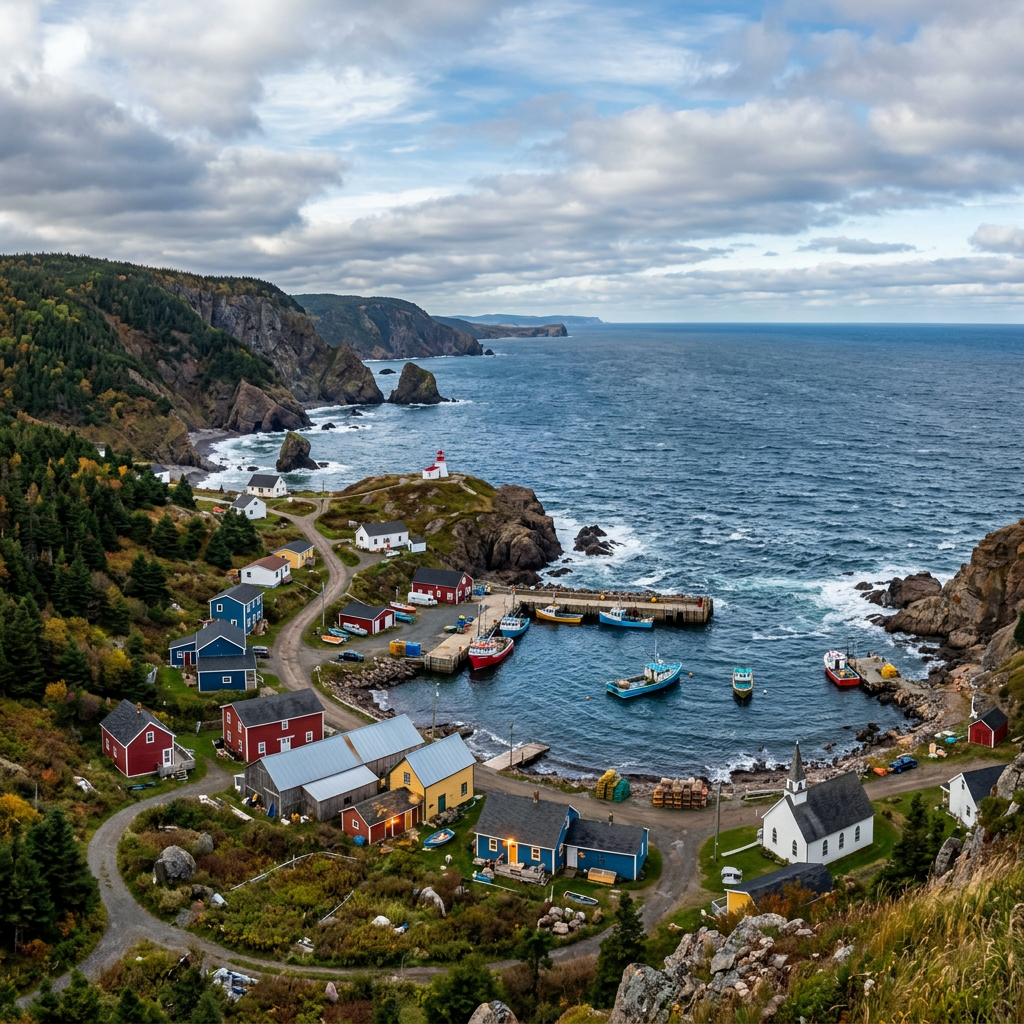
I was standing in a small town outside a small city in Nova Scotia last week. The person I was talking with gestured with pride to a group of small homes like attractive boxes scattered on the countryside above a cove., All the homes were recently redone. He mentioned that five years ago you could have bought any of them for just a few thousand Canadian dollars, but now they were worth a hundred thousand and up. Who was buying I asked. Folks from outside the local community. Elsewhere in the tour of the community, it was mentioned that young people in the community were beginning to have difficulty finding homes.
The conversation gave me pause because I saw the possible beginning of a pattern I had seen several times in the States: more affluent buyers move in, renovate, raise property values, and squeeze the market for housing. The community begins to be seen as more desirable to other property seekers, and they buy in too. The outsiders begin to see an invitation to acquire property in a “real” community, inexpensively. Gradually, the newcomers become a significant proportion of residents and begin to alter the cultural, economic, and social composition of the community. One of the effects of this can be the displacement of the next generation of children of local people.
My guide, hearing my concern as I expressed this, suggested that they were too isolated. I hope he is right. Economic improvement and a new population can be a true boon to small communities. But in my experience, the cardinal warning sign that a process of displacement has started is that locals and their children can’t afford to stay in their community. At its initiation, all seems well; only later can you assess the true cost.
I do not think that community planners weigh the balance between new growth and community stability. The difficult question is how much change and growth is a complement to a community versus how much starts a process that leads to altering the community to the point that it becomes a community in name only – just another housing development.
Community is easy to lose.
- Out of respect to the community, I’ve asked AI to conjure an image rather than use a potentially recognizable photo.
Discover more from Louis N. Carreras, Woodcarver
Subscribe to get the latest posts sent to your email.
The maritime provinces became a popular spot to move to during Covid when you could work from home and housing was cheap. Unfortunately, it did raise housing prices and what you described above is exactly what is happening.
Unfortunate for the local communities. What he was describing struck me as what I had seen Stateside, and I was worried that it was a widespread process. Thanks for the additional information,
You’re not wrong. There’s a long history of this, not just in the States but all over the place. Another big problem is Airbnb and its ilk. I know they are considered a real problem in the UK and in Europe. Same kind of deal, outsiders come in, etc. And yes, it is understandable. Who doesn’t want to sell their $20K home for $300K?
You’re not wrong. There’s a lot of history of what you are describing, and not just in the States. Another, very similar problem, is Airbnb, and that phenomenon is a big problem in the UK and parts of Europe. It is also understandable, as who wouldn’t want to sell their $30K home for $300K?
I don’t know if WP ate my previous comment or what. It’s been buggy for me lately. Sorry if this is a duplicate–feel free to delete.
Gentrification in action. That is what happened to the old neighborhood where I bought my first house when I moved down here. I could not afford to live there now.
That’s the pattern everywhere it happens.
My town keeps trying to gussy up. It wants to. BUT the big fancy house down the street has been on the market for 2 years and many people who move in move out after the first winter. BUT new businesses move in promising work — the question is “Will they last?” We just got a new AutoZone and a factory that makes tiny homes. Whoopdeedo. I imagine one goal is to make it easier for young people to stay in the valley. Seriously, when the local PO depends on the Amazon contract to stay in bidness??? That said, after 2021 housing prices went up here and they aren’t going down. That was good for me when I wanted a second mortgage, but generally? I don’t know…
Everybody wants “good development” but it’s not that easy to control once it starts. Communities with planners on staff, and prepared for possible zoning restrictions may fare better. Open the gates wide to all comers, and all circumstances, and you my get swamped.
In the ase of your community they amy just not be up on anyones radar yet.
Who knows? It had a little spurt in 2020-22 during the great Covid debacle, but most of the people who moved here (and some built very fancy farms!) moved some place more “user friendly.” Meanwhile I have Amazon Prime to keep people working at the PO. 🤣 It’s kind of strange, actually, because there’s good skiing only 30 miles up the road. The local mountains attract Texans in the summer so there’s that.
I think your community may be dodging the bullet. Like it or not.
I hope so. -25 F tends to keep small bidders out.
You are right about small communities changing. In my opinion the shift from commuting to work and working from home has a huge impact on this.
One of the other comments mentioned this. You can work from home, choose an atractive place to live, and either contribute to the community or not. That lastnbit is the really important part.
I have to wonder what will happen to the small communities — and cities even– when Mr T has his way with this new set of tariffs. Big news in Canada right now. Can you tell me what the underlying rationale really is here?
The CDN govt has staunchly protected our CDN dairy industry from a much larger US aggression. The US would do the same–and has done in similar circs. Small CDN dairy farmers can’t compete with certain cheaper-to-produce US products. It seems Mr T is really focused on this issue, gives it as one reason for 50% tariffs on CDN this and that.
Canadians reacted to the first slap of tariffs by not selling US alcohol in Canada and US wineries + brewers have felt it. So one excuse for the higher tariffs is to force our provinces to back down on that. Shouldn’t it be obvious, though, if you make people mad they won’t want to buy your stuff.
No tariff on our potash and oil, though, needed by US farmers and industry. And if we’d retaliate, sell all our potash to China, for example, would he send in the troops “to protect US interests”? Is that his ultimate game plan, do you think? Hit us as hard as he can so we’ll finally react and he can send in the military to take over?
what I read the other day on the CBC site indicated that some provinces don’t want US booze back under any circumstances.
The the orange one would do if Carney were to really retaliate I do not know. Starting a war with a peaceful neighbor and ally? One would hope that woud be one step too far. But normal rules have been overturned recently.
In anywise Canada woud not be a walkover. It would become a graveyard for the US troops.
I fervrently hope common sense prevails!
Though we’re little, my impression is that he’s portraying Canada as the greedy grasping villain, refusing US products, thus keeping the US economy from really prospering.
We’re the little guy, not in a position to retaliate. However, if the provinces opened wide to US booze, CDNs may still boycott it. People tend to resent being pushed. Now a 50% tariff seems like Kristelnacht American style.
Sorry to vent. I must stop reading the news. 😉
I’ve started to limit my reading because I start fuming, and there is little I can do until the midterms. When approached by Republicans for my vote, I plan on being formally polite. Neither vitriol nor reason will do any good with those people; I’ll just smile and say no thanks.
For the first time ever, I may also make a campaign contribution to a local Dem.
You raise an interesting point. Recently we visited a coastal city closer to where we live in Southern India. There is a small fishing village close to the city and was a sleepy little hamlet until a few years ago; however now following a sudden trend the uber rich have begun buying land there and building sea facing luxurious homes. While the local population, the fishing folks are happy to sell the land, I did notice some of the older homes between the massive houses and upon questioning we found out that some of the folks don’t wish to sell because this is where they have been living for generations. Sadly the land mafia will push them out eventually and that again brings me back to what happens to the future.
The term Land Mafia is a great description for what and how they operate. Thanks for your comment. I didn’t realize it was such a widespread phenomenon